
Why robotics has become one of today’s most strategic industries
Robotics is no longer a narrow factory-automation category. In 2025 and early 2026, it is clearer than ever that robotics is becoming a strategic layer of the modern economy. It now shapes advanced manufacturing, healthcare, logistics, warehouse operations, inspection, mobility, and the broader competitiveness of nations.
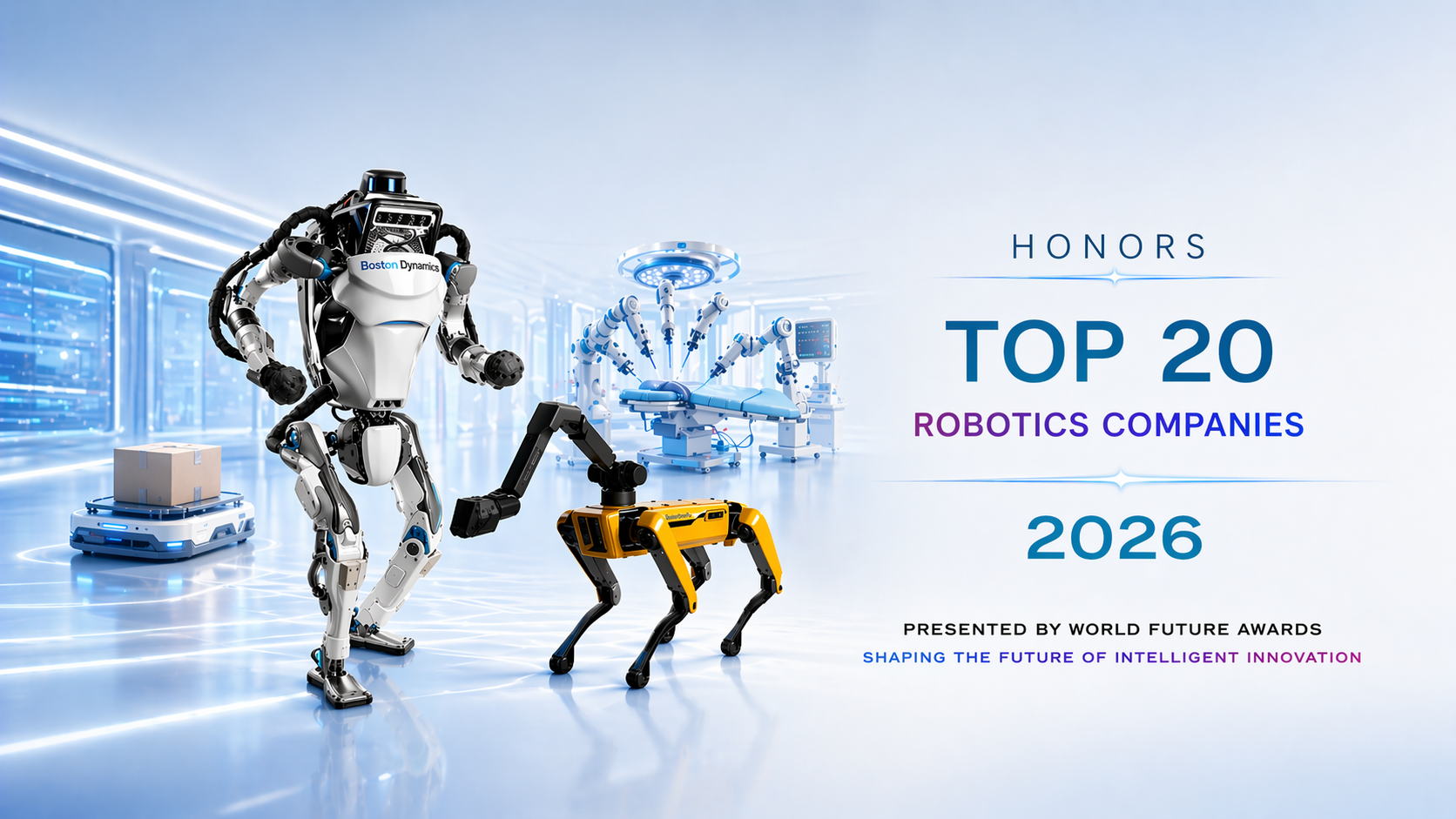
This is exactly why World Future Awards prepared its Top 20 Robotics Companies of the World research. The goal is not simply to highlight large names, but to examine the countries, companies, and technology shifts defining the global robotics market today.
The strongest robotics companies are no longer just selling machines. They are building intelligent systems that combine hardware, software, sensing, vision, control, and increasingly AI-enabled capabilities into scalable platforms for the real economy. That shift is what makes robotics one of the most important strategic industries to watch.
As of April 2026, the latest globally audited installation totals published by the International Federation of Robotics still refer to 2024 deployments. For that reason, this updated World Future Awards article combines the newest official global benchmark data released in 2025 and 2026 with 2025 company disclosures and market signals. This provides the freshest reliable picture currently available, without overstating what has and has not yet been officially reported.
The latest official market baseline
The latest official market baseline remains strong. According to IFR’s World Robotics 2025 release, 542,000 industrial robots were installed worldwide in 2024. Annual installations stayed above 500,000 units for the fourth consecutive year, while the global operational stock reached 4.664 million units.
In January 2026, the International Federation of Robotics also said that the market value of industrial robot installations had reached an all-time high of US$16.7 billion. Together, these figures confirm that robotics is operating at true global scale and continues to attract long-term industrial investment.
This matters because the robotics industry is no longer defined only by factory arms and repetitive automation. It now includes collaborative robots, autonomous mobile robots, medical robotics, drones, precision systems, and intelligent service platforms. The market is becoming broader, more software-driven, and more deeply integrated into real-world operations.

Where robotics leadership is concentrated
Robotics leadership is not only about market size. It is also about how deeply automation is embedded into a country’s industrial base.
According to the IFR April 2026 robot density update, Western Europe reached 267 robots per 10,000 manufacturing employees in 2024, ahead of North America at 204 and Asia at 131. At country level, South Korea remains the global benchmark for automation intensity with 1,220 robots per 10,000 employees. Singapore follows with 818, Germany with 449, and Japan with 446. The United States ranks eighth worldwide with 307.
These numbers are important because they show that robotics leadership is not just about buying robots. It is about embedding robotics deeply into industrial systems, productivity models, and national competitiveness.
China: the scale leader
China remains the scale leader in the global robotics market. IFR says that 295,000 industrial robots were installed in China in 2024, representing 54% of all global deployments. The country’s operational stock exceeded 2 million units. That is the clearest signal of where manufacturing-scale automation is happening fastest. IFR also notes that China still has significant room for further adoption and sees potential for robot demand in the country to continue growing by around 10% annually on average through 2028.
Japan: manufacturing depth and robotics production
Japan remains one of the most important robotics countries in the world for a different reason. It combines a large domestic market with deep manufacturing capability and a powerful base of robot producers. IFR continues to describe Japan as the world’s predominant robot manufacturing country. In 2024, Japan installed 44,500 industrial robots and had an operational stock of 450,500 units. IFR expects demand in Japan to grow slightly in 2025 before accelerating again at a medium single-digit pace in the years ahead.
Germany: Europe’s industrial robotics anchor
Germany remains Europe’s industrial robotics anchor. IFR recorded 26,982 robot installations in Germany in 2024, making it the largest robotics market in Europe and the fifth-largest worldwide. Germany also benefits from a strong engineering base, advanced system-integration expertise, and national R&D support. IFR notes that Germany’s High-Tech Strategy 2025 and related robotics research action plan are designed to strengthen research networks, skilled talent, and application-driven robotics innovation.
United States: high-value and frontier robotics
The United States stands out in high-value robotics segments such as surgical robotics, mobile systems, autonomous platforms, AI-enabled robotics, and software-centric deployment. IFR reports that robot density in the United States reached 307 in 2024. The country is also supported by major public research activity through institutions such as the NSF, NASA, and the Department of Defense. This helps explain why the U.S. remains especially influential in frontier robotics segments, even though it is not the global leader in manufacturing robot density.
2025 company signals: what robotics scale looks like now
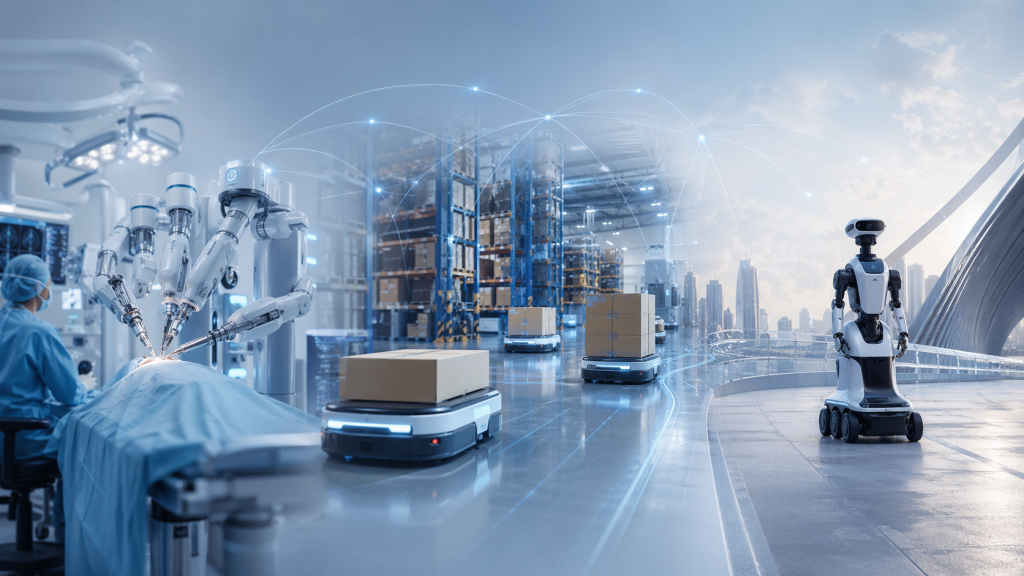
One of the clearest signs of fresh 2025 momentum comes from medical robotics. Intuitive reported preliminary 2025 revenue of approximately US$10.06 billion, up 21% from 2024. The company also reported roughly 3.153 million da Vinci procedures in 2025, an 18% increase year over year, and more than 12,100 systems in its installed base by year-end.
These are not marginal figures. They show that robotics in healthcare is now being deployed at major commercial and clinical scale, supported by recurring procedure growth and an expanding installed base.
Industrial robotics leaders also continue to show major scale in 2025. KUKA’s 2025 annual report describes the group as a global automation corporation with around €3.9 billion in sales and roughly 14,542 employees. FANUC’s Integrated Report 2025 says its ROBOT division recorded sales of ¥329,566 million for the year ended March 31, 2025, accounting for 41.3% of consolidated net sales.
These company signals reinforce a simple point: the global robotics sector is being shaped by a relatively small group of highly scaled companies whose influence extends far beyond individual product launches.
Why these Top 20 companies stand out
The medium-term growth case for robotics remains strong. In March 2026, IFR said that global industrial robot installations are forecast to surpass 700,000 units in 2028, representing a CAGR of about 7% from 2025 to 2028.
This suggests that the next phase of robotics growth will not be driven by one sector alone. It will be supported by a broader convergence of industrial automation, labor constraints, AI-enabled perception, autonomous mobility, and new deployment models across both manufacturing and services.
That is exactly why WFA’s Top 20 Robotics Companies of the World should be read as more than a list of major names. The companies in the accompanying spreadsheet represent different layers of the robotics stack: industrial arms, collaborative robots, autonomous mobile robots, medical platforms, drones, precision automation, and service systems.
Together, they show that robotics leadership today is distributed across multiple segments. The common denominator is the ability to turn intelligent automation into dependable real-world performance.
Conclusion
For World Future Awards, the core conclusion is clear. Robotics is no longer a peripheral technology theme. It is one of the defining strategic industries of the coming era.
China leads in scale. South Korea leads in automation intensity. Japan remains central to robotics manufacturing capability. Germany anchors European industrial robotics. The United States continues to shape high-value and frontier categories.
The companies that matter most are those building complete, intelligent, and deployable systems rather than isolated machines. That is the lens through which the global robotics market should now be understood.
As a companion to this article, we invite our readers to explore the Top 20 Robotics Companies of the World spreadsheet, which offers a curated overview of the companies, countries, and capabilities shaping today’s global robotics landscape.
| Country | Why it matters in robotics | WFA analytical take |
|---|---|---|
| 🇰🇷 South Korea | Automation intensity leader | Highest robot density in the world at 1,220 robots per 10,000 manufacturing employees. Strong electronics and automotive demand make it a benchmark for factory automation. |
| 🇨🇳 China | Scale leader | By far the world’s largest industrial robot market: 295,045 installations in 2024, 54% of global installations, and roughly 2 million robots in operation. |
| 🇯🇵 Japan | Manufacturing and robotics supply-chain leader | A top-five robot market and one of the world’s most important robot-manufacturing nations, home to FANUC, Yaskawa, Kawasaki, DENSO, Mitsubishi Electric, and Epson. |
| 🇩🇪 Germany | Europe’s industrial robotics leader | Europe’s largest robot market and third worldwide by robot density at 449. Germany remains a core base for industrial automation, systems engineering, and high-value manufacturing. |
| 🇺🇸 United States | Service, medical, and advanced mobile robotics leader | The U.S. ranks 8th worldwide in robot density at 307 and is especially strong in surgical robotics, warehouse robotics, field robotics, AI integration, and next-generation humanoids. |
| 🇨🇭 Switzerland | Precision automation and robotics champion | Switzerland punches above its size with globally important robotics and automation players such as ABB and Stäubli, plus a high-value industrial base. |
| 🇩🇰 Denmark | Cobot and AMR innovation cluster | Denmark is a global reference point for collaborative robots and autonomous mobile robots, led by Universal Robots and MiR in Odense’s robotics ecosystem |
| Rank | Company | Segment | Short overview |
|---|---|---|---|
| 1 | ABB Robotics, Switzerland | Industrial, collaborative, and mobile robotics | One of the world’s leading robotics suppliers, with industrial robots, cobots, AMRs, software, and automation solutions across automotive, electronics, logistics, and general industry. |
| 2 | FANUC, Japan | Industrial robotics and factory automation | A global automation heavyweight with one of the industry’s broadest robot portfolios, spanning compact units, heavy-payload robots, collaborative robots, and paint robots. |
| 3 | Yaskawa Electric, Japan | Industrial robots and motion control | Maker of the MOTOMAN line and a long-standing leader in industrial robotics, motion control, and factory automation with deep strength in welding, handling, and assembly. |
| 4 | KUKA, Germany | Industrial robots, software, intralogistics | A major European automation champion combining industrial robots, systems integration, software, and warehouse automation for manufacturing and intralogistics. |
| 5 | Kawasaki Robotics, Japan | Industrial, collaborative, and specialized robots | A pioneer of industrial robotics in Japan with solutions spanning welding, handling, palletizing, collaborative robotics, and specialized medical and pharma applications. |
| 6 | Universal Robots, Denmark | Collaborative robots (cobots) | The company that helped define the modern cobot category, with easy-to-deploy collaborative robot arms used widely by manufacturers and SMEs. |
| 7 | Mobile Industrial Robots (MiR), Denmark | Autonomous mobile robots (AMRs) | A leading AMR company focused on internal transport and material handling in factories, warehouses, and healthcare environments. |
| 8 | OMRON, Japan | Industrial robotics and integrated automation | OMRON combines industrial robots, AMRs, machine vision, sensing, and control systems to deliver end-to-end manufacturing automation. |
| 9 | Mitsubishi Electric, Japan | Industrial robots and factory automation | Through its MELFA robotics portfolio, Mitsubishi Electric serves precision manufacturing, electronics, and automated production environments. |
| 10 | DENSO WAVE, Japan | Small industrial robots and automation | A strong global player in compact industrial robotics, especially for high-speed, high-precision factory applications including electronics and component assembly. |
| 11 | Stäubli Robotics, Switzerland | Industrial robots for precision environments | Known for highly reliable robots used in demanding sectors such as electronics, cleanroom production, pharma, food, and advanced manufacturing. |
| 12 | Comau, Italy | Industrial automation and advanced robotics | An Italian automation leader with strong capabilities in robotics, digital manufacturing, electrification, and flexible industrial systems. |
| 13 | Intuitive, United States | Surgical robotics | The pioneer of robotic-assisted surgery, best known for the da Vinci platform and its leadership in minimally invasive robotic care. |
| 14 | Boston Dynamics, United States | Highly mobile and field robotics | A globally recognized robotics company building advanced mobile robots for industrial inspection, logistics, and next-generation humanoid applications. |
| 15 | DJI, China | Aerial robotics and intelligent platforms | The world’s most influential commercial drone company, with robotics capabilities spanning aerial imaging, industrial inspection, agriculture, logistics, and autonomous systems. |
| 16 | SIASUN, China | Industrial, mobile, and service robots | One of China’s largest robotics companies, covering industrial robots, mobile robots, special robots, and automation solutions for multiple industries. |
| 17 | ESTUN, China | Industrial robots and motion control | A major Chinese automation and robotics group with strengths in industrial robots, motion control, and production digitalization. |
| 18 | ECOVACS, China | Consumer and service robotics | A global consumer robotics leader best known for robotic floor-care systems, with a large installed base and broad international footprint. |
| 19 | Doosan Robotics, South Korea | Collaborative robots | One of the world’s fastest-growing cobot players, strong in high-payload collaborative robots and industrial automation use cases. |
| 20 | Epson Robots / Seiko Epson, Japan | SCARA and precision industrial robots | A long-established robotics business with major strength in SCARA robots and precision automation for electronics, medical, and small-parts manufacturing. |
This research reflects WFA’s editorial-analytical review of the global robotics sector, based on official 2025/2026 market releases and the most recent company disclosures available as of April 2026. The accompanying Top 20 Robotics Companies of the World list is designed as a curated industry shortlist rather than a pure revenue ranking.