

The Rise of the Physical AI Economy
Are Robots About to Become the New Workforce?
AI is moving beyond the screen. As intelligent machines begin to perceive, adapt and act in the physical world, a new question is emerging for business leaders: where will physical AI create the greatest competitive
For decades, robots have been remarkably good at doing exactly what they were programmed to do.
They weld the same joint thousands of times. They move the same component along the same production line. They sort packages, vacuum floors and transport materials along carefully defined routes.
But ask an old-generation robot to deal with an unexpected object, a crowded workspace or a task it has never seen before, and its limitations quickly become obvious.
That is beginning to change. In 2026, a new category of technology is moving from laboratories and demonstrations into factories, warehouses, logistics networks and other real-world environments: physical AI.
The idea is simple but profound. Instead of programming a machine for every possible situation, AI gives it the ability to perceive its surroundings, interpret what is happening, make decisions and adapt its actions in real time.
Deloitte describes physical AI as the convergence of AI and robotics that enables machines to perceive, understand, reason about and interact with the physical world. Its 2026 technology outlook argues that the transition from prototype to production is already underway.
That could make 2026 an important turning point.
Not because humanoid robots are suddenly ready to replace human workers everywhere. They are not.
But because the economic question is changing.
The question is no longer: “Can we build a robot that walks like a human?”
It is: “Can an intelligent machine perform useful work in the real world, safely and economically?”
And that is a much more consequential question.
From automation to physical intelligence
The first generation of industrial robotics was built around predictability.
A robot arm in an automotive factory could perform an incredibly precise sequence of movements, but the environment around it had to be designed for the robot.
Parts arrived in predictable positions. Workflows were standardized. Humans and machines were usually separated.
This model created enormous productivity gains, but it also created a boundary: traditional automation works best when the world behaves exactly as expected.
Physical AI attempts to remove some of those limitations.
Modern systems combine cameras, tactile sensors, spatial computing, onboard processors and AI models that can translate perception into physical action. A robot can potentially recognize an object, determine how to pick it up, understand where it needs to go and adjust its movements when something changes.
That sounds like a relatively small technical improvement.
It is not.
It represents a shift from automation to adaptation.
A traditional robot might be told: Pick up this object from this location and put it here.
A physical-AI system is being developed toward something closer to: Find the object, determine the best way to handle it, complete the task and adapt if the environment changes.
That distinction is at the heart of the robotics race now underway.
The factory is becoming the first proving ground
One of the clearest signs that this technology is moving beyond the hype cycle is the growing number of experiments inside actual industrial environments.
BMW provides a particularly interesting example.
In 2025, BMW’s Spartanburg plant in the United States deployed Figure AI’s Figure 02 humanoid robot. Over approximately ten months, the robot contributed to the production of more than 30,000 BMW X3 vehicles, moved more than 90,000 components and operated for around 1,250 hours.
The experiment was not about creating a futuristic spectacle.
The robot was performing repetitive, physically demanding work: retrieving and positioning sheet-metal parts for welding.
And BMW has continued the experiment.
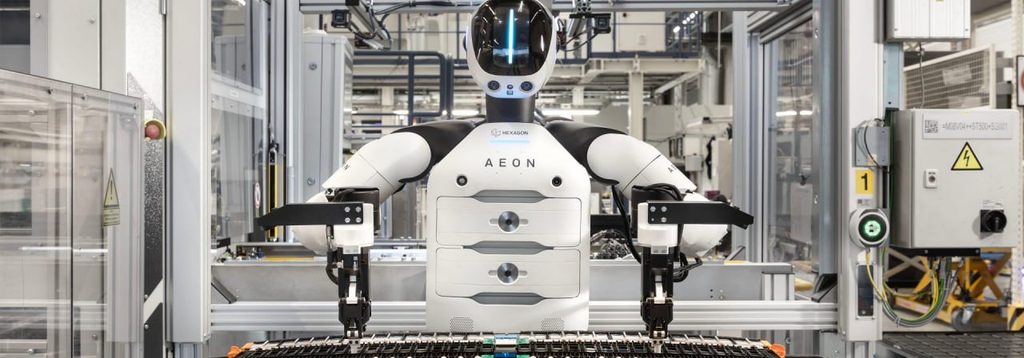
In 2026, the company introduced a new humanoid-robot pilot at its Leipzig plant, using AEON from Hexagon Robotics for tasks including high-voltage battery assembly and component production. BMW says the project is part of a broader effort to integrate physical AI into its global production system.
Figure has also returned to BMW’s Spartanburg operation with its newer Figure 03 robot, moving beyond the earlier pick-and-place application toward more complex logistics and sequencing tasks.
This matters because factories are unforgiving environments.
A robot demonstration can look impressive for five minutes.
A production line is different.
A production robot has to work repeatedly, safely, predictably and at a cost that makes commercial sense.
That is the real test.
Why companies are interested now
The sudden interest in physical AI is not being driven by technology alone.
There is an economic problem waiting for a solution.
Many industries are facing labor shortages, aging workforces and difficulty filling physically demanding or repetitive positions.
The International Federation of Robotics identifies labor gaps as one of the major robotics trends of 2026, arguing that automation can help companies address shortages while allowing workers to move toward higher-value activities.
This changes the narrative around robots.
For years, the public debate was largely framed as: Will robots take our jobs?
In many industries, the more immediate question may be: Who will do the jobs if there aren’t enough people to do them?
That distinction is important.
A warehouse struggling to recruit workers for repetitive material handling may not be looking for a machine to replace its entire workforce.
It may simply need a way to handle tasks that are difficult to staff.
A manufacturing company may want robots to perform repetitive lifting while employees focus on quality control, process management and problem solving.
A hospital may use robots to transport materials so medical staff can spend more time with patients.
A construction company may eventually use autonomous machines for dangerous or physically exhausting tasks.
The most successful applications may therefore be the ones where human capabilities and machine capabilities complement each other.
The humanoid question
So why humanoid robots?
If the goal is simply automation, why build a machine with two arms and two legs?
The answer is surprisingly practical.
Our world has been designed for human bodies.
Factories, warehouses, stairs, tools, shelves, vehicles, doors and workstations were largely designed around the way humans move.
A humanoid robot could potentially operate within those environments without requiring companies to redesign everything around a specialized machine.
That does not automatically make humanoids the best solution.
In many cases, a wheeled robot, robotic arm or specialized autonomous machine will remain cheaper and more efficient.
But general-purpose humanoids could become attractive where flexibility matters more than maximum efficiency on a single task.
That is why the competition is intensifying.
China’s Unitree, for example, is rapidly expanding its humanoid robotics business and preparing for a major public-market debut. Reuters reported this month that the company had delivered around 18,000 bipedal humanoid robots across its models as of July.
The company has also attracted investment from Chinese AI startup DeepSeek, which Reuters reported acquired a 2.31% stake during Unitree’s Shanghai IPO process. The companies plan to collaborate around AI, robotics and embodied intelligence.
Meanwhile, Nvidia is increasingly positioning itself as part of the robotics ecosystem, providing the computing platforms and AI technologies that allow machines to perceive and act in physical environments. Nvidia’s partnerships now extend into humanoid robotics, including work with LG and Unitree.
The competition is therefore becoming much broader than a race between robot manufacturers.
It is becoming a race involving:
AI models + chips + sensors + robotics + data + manufacturing + energy + software.
The missing ingredient: data from the physical world
There is, however, one enormous challenge.
AI models became powerful partly because the digital world generated an extraordinary amount of training data.
The internet gave machines access to text, images, video, code and other forms of information at unprecedented scale.
Robots do not have that luxury.
A robot needs to understand:
- friction
- weight
- balance
- force
- distance
- movement
- spatial relationships
- physical consequences
- human behavior
And collecting that data is difficult.
You cannot simply download a trillion examples of how to pick up a fragile object in every possible environment.
Robotics companies therefore rely increasingly on simulation, synthetic data, teleoperation, imitation learning and reinforcement learning to teach machines how to operate.
Deloitte notes that physical AI increasingly combines simulation, synthetic data, reinforcement learning and imitation learning to help robots develop behaviors before those systems are deployed in the real world.
But simulation has limits.
The real world is messy.
A simulated floor does not have exactly the same friction as a real floor. A virtual object does not have the same weight distribution as a physical one. People behave unpredictably.
Teaching a machine to operate safely in this environment may ultimately require enormous amounts of real-world experience.
That could make physical-world data one of the most valuable assets in the next generation of AI.
The robot’s “body” may become as important as its brain
There is another important shift happening.
The robotics race is not only about increasingly intelligent software.
It is also about better hardware.
Robots need:
- better batteries
- lighter motors
- more capable actuators
- advanced cameras
- tactile sensors
- edge computing
- improved hands and grippers
- faster communication
- safer movement systems
One particularly interesting frontier is robotic touch.
Humans don’t just see objects. We feel them.
We know how hard to grip a glass without crushing it. We can detect when something starts slipping from our hand. We can manipulate objects without consciously calculating every movement.
Robots still struggle with these seemingly simple abilities.
New electronic-skin technologies are now being developed to give robots greater tactile sensitivity, potentially allowing machines to detect pressure, force and slipping in ways that more closely resemble human touch.
That may sound like a small engineering detail.
It isn’t.
The closer machines get to sensing the world as humans do, the wider the range of physical tasks they may eventually be able to perform.
What happens to human jobs?
This is where the conversation becomes much more complicated.
There is no credible reason to believe that humanoid robots will simply replace humans across the economy in the next few years.
The technology is still expensive. Reliability remains a challenge. Safety standards are evolving. Many tasks are far more difficult to automate than they appear.
And physical intelligence is not the same thing as human intelligence.
A robot may become extraordinarily good at a particular physical task while still struggling with basic common-sense situations that humans handle effortlessly.
But that does not mean the impact on employment will be small.
Technology does not need to replace an entire occupation to change it.
It only needs to change the tasks within it.
Consider a warehouse worker.
If a robot takes over lifting and moving repetitive loads, the human role could shift toward supervising machines, managing exceptions, checking quality and solving operational problems.
A technician may spend less time physically carrying components and more time maintaining intelligent systems.
A factory worker may become an operator of robotic systems rather than simply an operator of machinery.
In other words, the future workplace may not be:
Humans vs. robots.
It may increasingly become:
Humans managing, directing and collaborating with robots.
That shift will require new skills.
And that may ultimately be one of the biggest challenges of the physical AI revolution.
The biggest opportunity may be boring
There is a tendency for technology media to focus on spectacular robots.
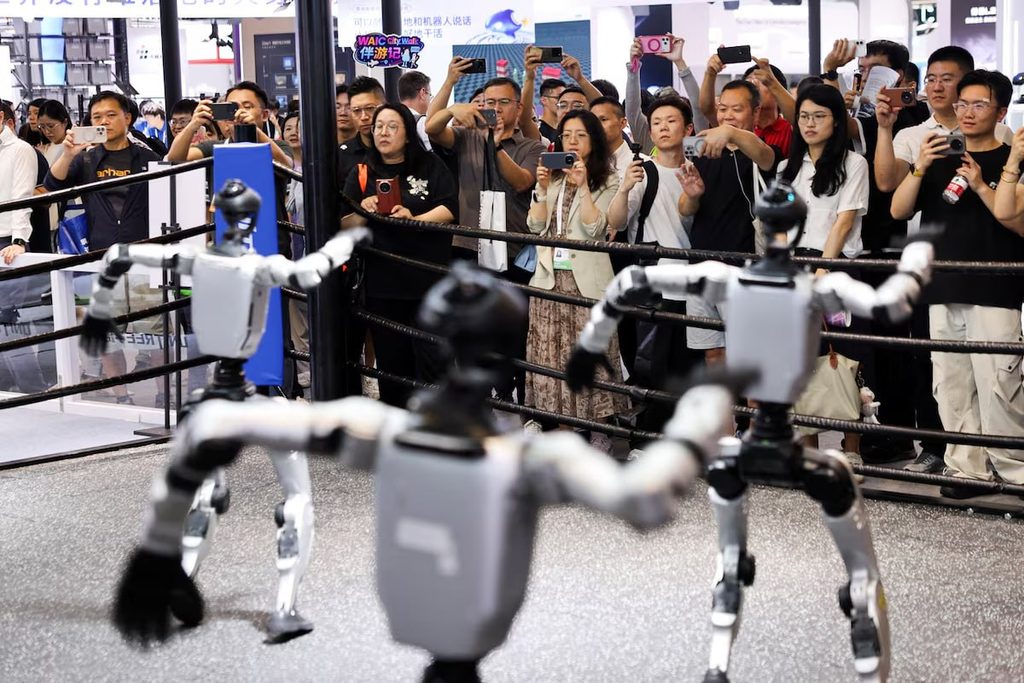
A robot dancing.
A robot running.
A robot doing a backflip.
A robot talking to a journalist.
These demonstrations are entertaining, but they are not necessarily economically important.
The real breakthroughs may be much less glamorous.
A robot that can reliably unload a truck for eight hours.
A machine that can inspect a power line without putting a human at risk.
A system that can move hospital supplies through a building overnight.
A robot that can work alongside a human on a manufacturing line without stopping production.
A machine that can adapt when something goes wrong instead of waiting for an engineer.
Those are the applications that could transform industries.
The measure of success will not be:
“Does the robot look human?”
It will be: “Does the robot solve a real problem?”
What could happen next?
If the current trajectory continues, the next few years could produce a gradual rather than sudden transformation.
First, robots will remain concentrated in controlled environments.
Factories.
Warehouses.
Distribution centers.
Hospitals.
Infrastructure sites.
Then, as perception, reasoning, mobility and safety improve, machines will begin operating in increasingly unpredictable environments.
That could eventually bring physical AI into construction, agriculture, retail, hospitality and domestic environments.
But there is an important caveat.
The technology will not develop in isolation.
Regulation, insurance, labor policy, safety standards, cybersecurity and public acceptance will all influence how quickly robots enter everyday life.
Deloitte notes that scaling physical AI requires collaboration between technology providers, enterprises and regulators.
That means the physical AI revolution is not simply an engineering challenge.
It is an economic and social one.
The real question isn’t whether robots will work
The technology industry has spent years asking whether AI can think.
Now it is asking whether AI can act.
That is a different challenge.
A digital AI system can generate an incorrect paragraph.
A physical AI system can drop a heavy object.
A chatbot can give bad advice.
A robot can physically hurt someone.
That makes safety, reliability and human oversight fundamental.
As machines gain greater autonomy, society will need to decide where autonomy is acceptable, where human control is mandatory and who is responsible when an autonomous system makes a mistake.
The answers will not come entirely from engineers.
They will require policymakers, business leaders, workers, researchers and the public to participate in shaping the rules.
From artificial intelligence to physical intelligence
The most interesting thing about robotics in 2026 is not that machines are becoming more human-like.
It is that AI is becoming physical.
For most of the modern AI boom, intelligence existed on screens.
Now it is beginning to inhabit machines that can move through factories, streets, warehouses and eventually our homes.
That changes the scale of the opportunity.
Software can transform how we communicate.
Physical AI could transform how we build, manufacture, transport, maintain, explore and work.
The winners of this next technological era may not simply be the companies with the smartest AI.
They may be the companies that figure out how to connect intelligence with the physical world in a way that is useful, safe and economically sustainable.
And perhaps the biggest question for the workforce is not whether machines will take our jobs.
It is whether we will be ready to work alongside them.
What do you think?
If physical AI continues to advance at its current pace:
Which industry will be transformed first by intelligent robots: manufacturing, logistics, healthcare, construction, agriculture or something else?
And perhaps the more important question:
Would you trust an intelligent robot to work alongside you?
Share your perspective.
About World Future Awards
At World Future Awards, we follow the technologies, companies and people turning ambitious ideas into real-world impact.
From artificial intelligence and robotics to space technology, advanced manufacturing, energy and emerging technologies, our focus is on the innovations that have the potential to shape the future.
Is your company building one of them?
Applications for the World Future Awards are open to innovative companies, startups and technology leaders from around the world.
Apply now: World Future Awards Applications
MORE NEWS
TOP 20 FUTURE TECH UNIVERSITIES 2026
VVater Wins WFA 2026 for Next-Generation Sustainable Water Treatment Technology

VVater: Electrifying the Future of Sustainable Water Treatment
The New Space Race Is Becoming a Technology Race

Top 25 Biotech Breakthroughs Shaping 2026
50 Venture Tech Companies and Leaders to Watch in 2026
The New Game Masters: World Leaders Shaping the Future of Gaming
NEWSLETTER
Sign up to learn more about our project and to stay up to date.