

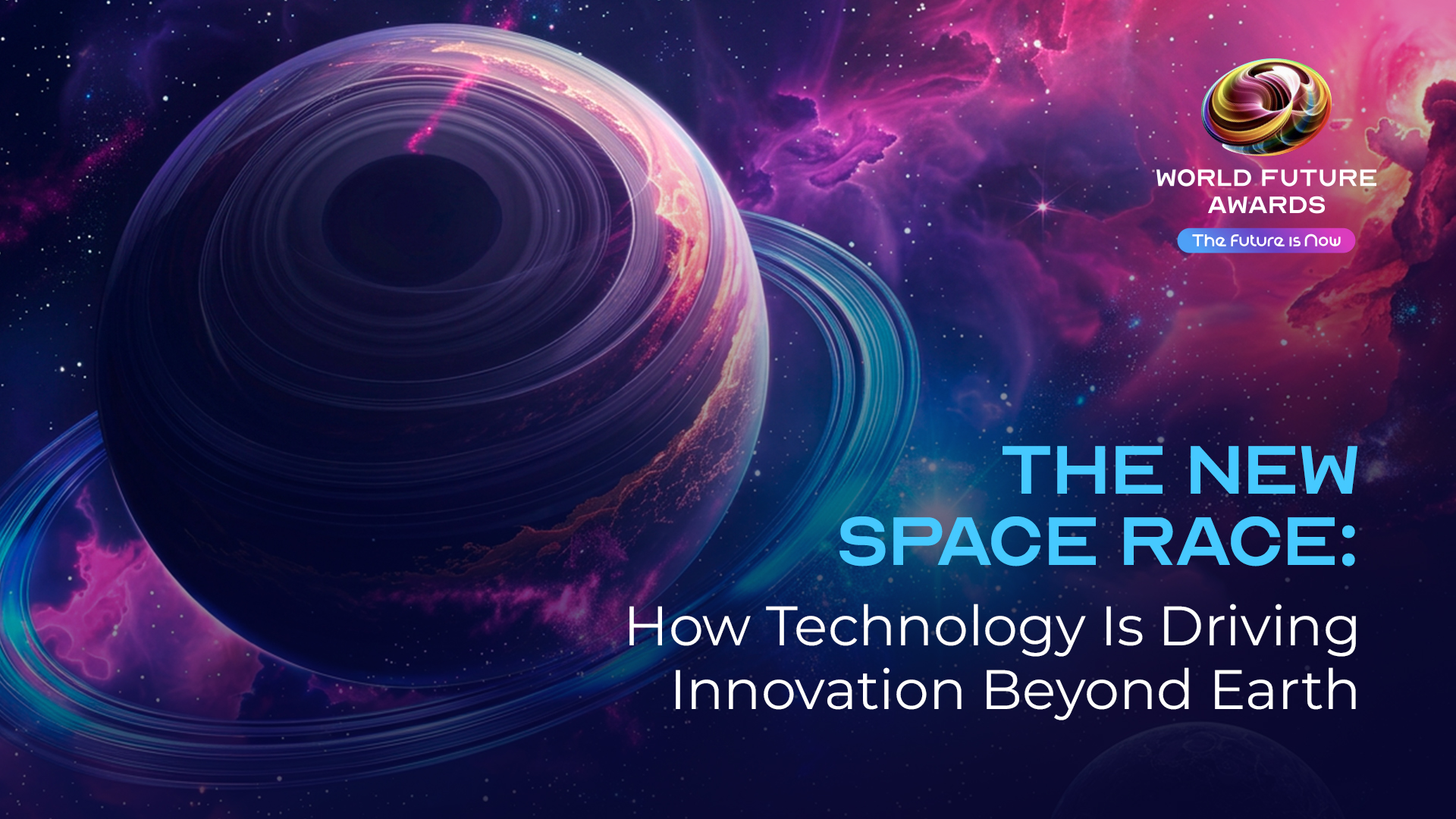
The New Space Race Is Becoming a Technology Race
Beyond Earth: Why Space Is Becoming the Next Innovation Platform
The space race is entering a new chapter.
For much of the 20th century, space exploration was defined by historic firsts: the first satellite, the first human in orbit, the first Moon landing. Governments invested enormous resources in proving that something could be done.
Today, the focus is shifting.
Space is becoming more commercial, more connected and increasingly driven by technologies that can operate with less human intervention. Rockets are still essential, but they are only one part of a much larger ecosystem that includes artificial intelligence, robotics, satellite networks, advanced materials, biotechnology and autonomous systems.
The new space race is no longer simply about reaching space. It is about making space useful.
From exploration to infrastructure
The transformation is already visible in Earth’s orbit.
Satellites have become essential infrastructure for communications, navigation, weather monitoring, Earth observation and data services. At the same time, launch costs and new commercial models have made it possible for more companies to participate in the space economy.
According to the OECD’s Space Economy at a Glance 2026, more than 14,000 active satellites were operating around Earth at the end of 2025. Private operators accounted for 88% of satellites launched during the year, compared with just 23% in 2010.
This growth is changing the nature of the industry.
Space is increasingly looking less like a collection of extraordinary missions and more like a technology ecosystem — one where data, computing, communications and automation have to work together continuously.
Intelligence is moving into orbit
One of the most important developments is the growing role of artificial intelligence.
Spacecraft generate enormous amounts of data, but sending everything back to Earth for analysis is not always the most efficient approach. More capable onboard computing and AI could allow spacecraft to process information closer to where it is collected.
NASA and IBM, for example, have developed an open-source Lunar Foundation Model intended to help researchers work with lunar data and identify geological features, including potential water-ice deposits.
This represents a broader direction for the industry.
Future spacecraft will increasingly need to do more than observe. They will need to interpret information, identify changes and support decisions with limited communication from Earth.
In this sense, intelligence itself is becoming part of space infrastructure.
Robots will extend human reach
The further humanity moves from Earth, the more important autonomous technology becomes.
Communication delays, extreme environments and the cost of sending humans everywhere make robotics a natural part of future exploration and infrastructure.
NASA’s CAPSTONE programme has already tested technologies connected with autonomous navigation and communications in lunar orbit. Future missions are expected to develop these capabilities further, including autonomous navigation and spacecraft coordination.
Robots could eventually perform many of the difficult and repetitive tasks required to establish a sustained presence beyond Earth — from inspecting equipment to transporting materials and supporting construction.
This is where space technology starts to overlap with robotics, AI and advanced manufacturing on Earth.
The Moon as a proving ground
The Moon is becoming particularly important because it offers a nearby environment for testing technologies that could eventually support deeper space exploration.
NASA’s Commercial Lunar Payload Services programme has created opportunities for private companies to deliver scientific and technological payloads to the lunar surface.
But a successful lunar mission is about much more than landing.
Long-term activity on the Moon will require dependable power, communications, navigation, transportation, robotics, materials and resource-management technologies.
In other words, the challenge is shifting from landing somewhere to building the systems that allow activity to continue once you arrive.
That is a very different kind of space race.
Space could also become a laboratory
Some of the most interesting opportunities may come from technologies that use space to solve problems back on Earth.
Microgravity creates conditions that cannot easily be reproduced on our planet. Researchers and companies are exploring its potential for pharmaceutical research, biotechnology, materials and manufacturing.
At the same time, satellites are already providing services with direct benefits on Earth, from monitoring environmental changes to supporting communications and observing agricultural and industrial activity.
The relationship between Earth and space is therefore becoming increasingly circular:
Technology goes into space.
New capabilities are developed there.
The benefits can return to Earth.
The less visible technologies may matter most
The future of the space economy will not be built entirely around spectacular launches.
Some of the most important innovations may be much less visible.
Better energy systems.
More resilient materials.
Autonomous navigation.
Space communications.
Robotic maintenance.
Advanced computing.
Lunar logistics.
Manufacturing in microgravity.
Each solves a practical problem. Together, they create the foundations for a much larger ecosystem.
This is also why space is increasingly connected to other areas of innovation. The World Future Awards recognises Space alongside categories including Artificial Intelligence, Robotics & Machine Intelligence, Biotechnology, Chemicals & Materials, Telecommunications, Drones and Green & Alternative Energy.
The boundaries between these industries are becoming less clear — and that is where some of the most interesting innovation is happening.
Space is becoming a platform
Perhaps the biggest change is the way we think about space itself.
For generations, space was primarily somewhere to explore.
Now it is becoming somewhere to operate.
Satellites form networks. Autonomous spacecraft navigate orbit. Robots can work in extreme environments. Researchers study biology and materials in microgravity. Companies are developing infrastructure and services around an increasingly active space economy.
The next stage will be about connecting all of these capabilities.
AI will make systems smarter.
Robotics will extend human reach.
New materials will make extreme environments more manageable.
Communications will connect increasingly distant operations.
And new commercial models will help turn individual technologies into functioning ecosystems.
The first space race demonstrated that humanity could leave Earth.
The new one is about discovering what humanity can build once it gets there.
And that may prove to be an even more transformative chapter.
💬 What technology will have the biggest impact on the future of space?
Share your thoughts with World Future Awards — we want to hear from the people building, investing in and imagining what comes next.
MORE NEWS
TOP 20 FUTURE TECH UNIVERSITIES 2026
VVater Wins WFA 2026 for Next-Generation Sustainable Water Treatment Technology

VVater: Electrifying the Future of Sustainable Water Treatment

Top 25 Biotech Breakthroughs Shaping 2026
The Rise of the Physical AI Economy
50 Venture Tech Companies and Leaders to Watch in 2026

The New Game Masters: World Leaders Shaping the Future of Gaming
NEWSLETTER
Sign up to learn more about our project and to stay up to date.