
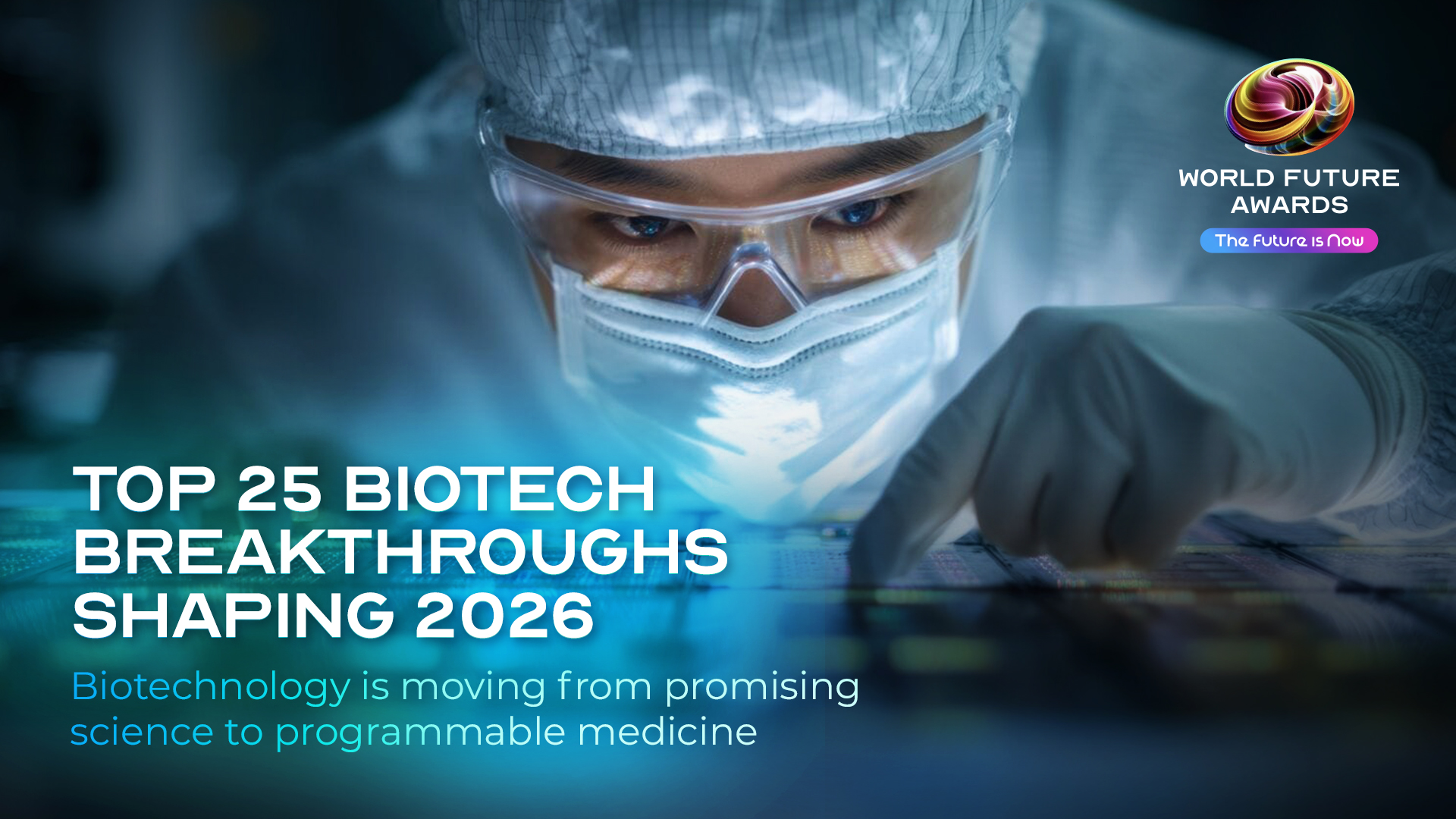
Top 25 Biotech Breakthroughs Shaping 2026
From AI-designed medicines and precision gene editing to cancer vaccines, engineered cells and next-generation healthcare, these are the technologies and companies changing the future of biology.
Biotechnology has entered a different kind of era.
For decades, some of the industry’s biggest ideas lived mostly in laboratories: gene editing, engineered cells, computational drug discovery, personalized medicine and synthetic biology. In 2026, many of these technologies are moving closer to something much more consequential – real-world clinical and commercial applications.
The change is not being driven by one breakthrough.
It is happening where AI meets biology, genetics meets engineering, and massive datasets meet increasingly precise therapeutic technologies.
That convergence is creating a new generation of biotech companies capable of tackling problems that were once considered too complex, too expensive or simply impossible.
Why 2026 Matters for Biotech
The industry’s focus is shifting from possibility to proof.
AI is moving beyond experiments and into actual R&D workflows. Benchling’s 2026 biotech AI research found that leading use cases already include literature review, protein structure prediction, scientific reporting and target identification, while the biggest challenges remain data quality and validation.
At the same time, gene, cell and RNA therapies continue to expand. The ASGCT 2026 Q2 landscape report recorded eight new gene, cell and RNA therapy approvals, while also highlighting accelerated development of mRNA-encoded CAR-T approaches.
But the market is becoming more disciplined. KPMG’s 2026 outlook notes significant headwinds for cell and gene therapy investment, showing that scientific promise alone is no longer enough: clinical evidence, safety, manufacturing and commercial viability matter just as much.
That makes 2026 particularly interesting.
The biotech industry’s next chapter will be decided not by the most exciting idea, but by the technologies that can cross the gap between breakthrough science and measurable human impact.
25 Biotech 25 BREAKTHROUGHS TO WATCH BY WFA EDITORIAL TEAM:
| # | Company | Breakthrough to watch | Field |
|---|---|---|---|
| 01 | Isomorphic Labs | AI-powered drug discovery and molecular design | AI + Drug Discovery |
| 02 | Recursion | AI + automated biological experimentation | AI + Drug Discovery |
| 03 | Generate:Biomedicines | Generative AI for protein therapeutics | Generative Biology |
| 04 | Xaira Therapeutics | AI-native drug discovery | AI + Biotech |
| 05 | Insilico Medicine | AI-designed drug candidates | AI + Drug Discovery |
| 06 | Beam Therapeutics | Precision base editing | Gene Editing |
| 07 | Prime Medicine | Prime editing for genetic diseases | Gene Editing |
| 08 | Verve Therapeutics | In-vivo gene editing for cardiovascular disease | Gene Editing |
| 09 | CRISPR Therapeutics | CRISPR-based medicines | Gene Editing |
| 10 | Intellia Therapeutics | In-vivo CRISPR therapies | Gene Editing |
| 11 | Scribe Therapeutics | Engineered CRISPR platforms | Gene Editing |
| 12 | Wave Life Sciences | RNA editing | RNA Medicine |
| 13 | Sana Biotechnology | In-vivo cell engineering | Cell Therapy |
| 14 | Umoja Biopharma | In-vivo CAR-T | Cell Therapy |
| 15 | eGenesis | Gene-edited organs for transplantation | Xenotransplantation |
| 16 | Moderna | Personalized mRNA cancer vaccines | Oncology / mRNA |
| 17 | Revolution Medicines | RAS-targeted cancer treatment | Oncology |
| 18 | BioNTech | Next-generation mRNA and cancer immunotherapy | Oncology / mRNA |
| 19 | Eli Lilly | Next-generation metabolic medicine | Metabolic Health |
| 20 | Novo Nordisk | Oral GLP-1 and metabolic medicine | Metabolic Health |
| 21 | Neko Health | Data-driven preventive healthcare | Preventive Health |
| 22 | Tempus AI | AI-powered precision medicine | Health AI |
| 23 | Retro Biosciences | Cellular rejuvenation research | Longevity |
| 24 | Ginkgo Bioworks | Biological engineering at scale | Synthetic Biology |
| 25 | Enveda Therapeutics | AI + natural-product drug discovery | Drug Discovery |
This is a curated watchlist, not a ranking of clinical efficacy or investment performance. The companies represent different stages of development, from research platforms to clinical and commercial programs.
1. AI IS BECOMING PART OF THE DRUG-DISCOVERY ENGINE
The first biotech revolution of the AI era was about prediction.
The next one is about design.
Companies such as Isomorphic Labs, Recursion, Generate: Biomedicines, Xaira Therapeutics and Insilico Medicine are building systems that use machine learning to understand biological data, identify targets, design molecules or proteins and accelerate experimentation.
The important shift is that AI is becoming embedded in the R&D process rather than existing as a separate technology layer.
Recent research in Nature Reviews Drug Discovery argues that the field is now moving toward a more evidence-driven understanding of where AI genuinely improves drug discovery and development.
Insilico offers a particularly interesting example. Its CEO Alex Zhavoronkov said in July 2026 that integrating AI with its research operations had reduced parts of its drug-development timeline dramatically, although its candidates still require the full clinical and regulatory process.
The future question is no longer whether AI can participate in drug discovery. It is where it can produce measurable clinical advantage.
2. GENE EDITING IS MOVING CLOSER TO THE PATIENT
CRISPR changed the scientific conversation. The next generation is changing the therapeutic one.
Base editing, prime editing and in-vivo gene editing are expanding the possibilities of genetic medicine.
Companies including Beam Therapeutics, Prime Medicine, Verve Therapeutics, CRISPR Therapeutics, Intellia Therapeutics and Scribe Therapeutics are exploring ways to correct, silence or rewrite disease-associated genetic information.
The attraction is obvious: instead of managing a disease indefinitely, some therapies aim to address its biological cause.
But this is also where caution matters most. Gene editing remains technically demanding, and clinical safety, delivery and durability are central questions.
The breakthrough is not simply being able to edit DNA. It is learning how to do it safely, precisely and at scale.
3. WHAT IF THE BODY COULD MANUFACTURE ITS OWN THERAPY?
One of the most intriguing directions in biotechnology is in-vivo cell engineering.
Traditional CAR-T therapy involves taking cells from a patient, engineering them outside the body and then returning them.
Companies such as Umoja Biopharma and Sana Biotechnology are exploring approaches that could move more of this process inside the patient.
ASGCT’s 2026 Q2 report highlights accelerating development of mRNA-encoded CAR-T approaches, illustrating how quickly the cell-therapy landscape is evolving.
If successful, these approaches could potentially simplify manufacturing and make sophisticated cell therapies more accessible.
It is one of the clearest examples of biotech moving from engineering cells outside the body to engineering biology inside it.

4. CAN WE ENGINEER NEW ORGANS?
The global shortage of transplantable organs remains one of medicine’s most difficult problems.
eGenesis is pursuing a radically different answer: genetically engineered pig organs designed for human transplantation.
The concept brings together gene editing, immunology, transplantation and animal biotechnology.
It also represents a much bigger idea:
What if the supply of organs could eventually become an engineering problem rather than a donor problem?
The science is still developing, and major questions around safety, rejection and long-term outcomes remain.
But xenotransplantation is no longer purely theoretical – making it one of the most important areas to watch.
5. THE CANCER VACCINE GETS A NEW LIFE
For years, scientists have searched for ways to turn the immune system into a personalized weapon against cancer.
mRNA technology may offer one of the most promising routes.
Moderna and Merck’s personalized cancer vaccine program has become a major example of this approach, with late-stage melanoma data reported in August 2026 showing significant efficacy.
The concept is strikingly different from a conventional vaccine.
Instead of giving every patient the same treatment, the vaccine can be designed around mutations identified in an individual’s tumor.
The idea is simple to explain, but extraordinarily complex to execute: teach the immune system what makes a particular cancer different.

6. THE “UNDRUGGABLE” CANCER TARGETS ARE BECOMING DRUGGABLE
Cancer research has spent decades trying to attack RAS, a family of proteins involved in many cancers.
In August 2026, Revolution Medicines received accelerated FDA approval for Rasonque, a RAS-targeted treatment for metastatic pancreatic cancer.
The significance goes beyond one drug.
It illustrates a broader shift in oncology: advances in molecular biology, structure-based design and precision medicine are making previously difficult targets increasingly accessible.
The oncology breakthroughs of the next decade may come from targets scientists once thought they could not reach.
7. METABOLIC MEDICINE IS BECOMING MUCH BIGGER THAN WEIGHT LOSS
GLP-1 drugs transformed the obesity conversation.
The next phase is broader.
Researchers and pharmaceutical companies are exploring how metabolic therapies could affect diabetes, cardiovascular disease and other chronic conditions.
Eli Lilly and Novo Nordisk remain central players in this race, while the industry is increasingly exploring oral formulations and next-generation mechanisms.
This is a good example of a broader biotech trend:
A successful therapy can create an entirely new biological platform — and then expand far beyond its original indication.
8. HEALTHCARE IS MOVING TOWARD PREDICTION
Another major change is happening outside traditional drug development.
Companies such as Neko Health and Tempus AI are building systems around the idea that better data can help healthcare detect risk earlier and personalize treatment.
The underlying ambition is a shift from:
“Treat the disease.”
to:
“Understand the biology before the disease becomes advanced.”
AI-enabled diagnostics and digital health are among the areas executives identify as important development priorities for 2026.
9. CAN AGING BECOME A BIOLOGICAL ENGINEERING PROBLEM?
Longevity remains one of biotech’s most controversial — and fascinating — frontiers.
Retro Biosciences is investigating cellular mechanisms associated with aging and rejuvenation.
The important point is not whether humanity will “live forever.” There is no evidence to make that claim.
The much more credible question is:
Can specific biological processes associated with aging eventually become therapeutically modifiable?
That question alone is enough to make longevity one of the fields worth watching closely.
THE BIGGER PICTURE
Across all 25 companies, one pattern keeps appearing:
biology is becoming increasingly programmable.
AI helps scientists model it.
Gene editing changes it.
RNA can instruct it.
Cell therapy can redirect it.
Synthetic biology can engineer it.
Data can measure it.
And increasingly sophisticated clinical systems can test whether those interventions actually help patients.
This convergence is changing the economics and the philosophy of biotech.
Deloitte’s 2026 Life Sciences Outlook found that executives expect cell, gene and RNA therapies to be among the modalities contributing most to revenue growth over the next two to three years.
Meanwhile, IQVIA reports that AI capabilities are increasingly influencing discovery, clinical planning, operations, portfolio decisions and regulatory processes.
WHAT COMES NEXT?
The next three to five years will likely be less about spectacular laboratory demonstrations and more about proof.
Can an AI-designed drug succeed in humans?
Can gene editing remain precise enough for widespread use?
Can cell therapies become easier and cheaper to manufacture?
Can engineered organs survive long term?
Can personalized cancer vaccines work across different tumor types?
Can preventive health systems actually improve outcomes rather than simply produce more data?
These are the questions that will separate biotechnology’s most important breakthroughs from its most exciting experiments.
And that may be the defining theme of biotech’s next chapter:
Proof over promise.
WHY THESE BREAKTHROUGHS MATTER
The companies on this list are working on very different technologies.
But they share a common ambition: to make biology more understandable, measurable and ultimately more controllable.
That is why biotechnology deserves attention far beyond the pharmaceutical industry.
The breakthroughs emerging today could influence how we prevent disease, develop medicines, treat cancer, manage chronic conditions, replace organs and understand aging.
The future of medicine may not simply be about discovering better drugs.
It may be about learning to program biology itself.
Resources & Research
Selected open research and industry sources:
- Nature Reviews Drug Discovery — Artificial intelligence in drug discovery: what it is, where we stand and the path forward, August 2026.
- IQVIA Institute — Global R&D Trends 2026.
- Deloitte — 2026 Life Sciences Outlook.
- ASGCT / Citeline — 2026 Q2 Quarterly Landscape Report.
- Benchling — 2026 Biotech AI Report.
- KPMG — Healthcare & Life Sciences Investment Outlook 2026.
- Recent company announcements and clinical updates.
- FDA regulatory information.
- Reuters and other reputable international business and healthcare media.
MORE NEWS
TOP 20 FUTURE TECH UNIVERSITIES 2026

VVater Wins WFA 2026 for Next-Generation Sustainable Water Treatment Technology

VVater: Electrifying the Future of Sustainable Water Treatment
The New Space Race Is Becoming a Technology Race
The Rise of the Physical AI Economy
50 Venture Tech Companies and Leaders to Watch in 2026
The New Game Masters: World Leaders Shaping the Future of Gaming
NEWSLETTER
Sign up to learn more about our project and to stay up to date.