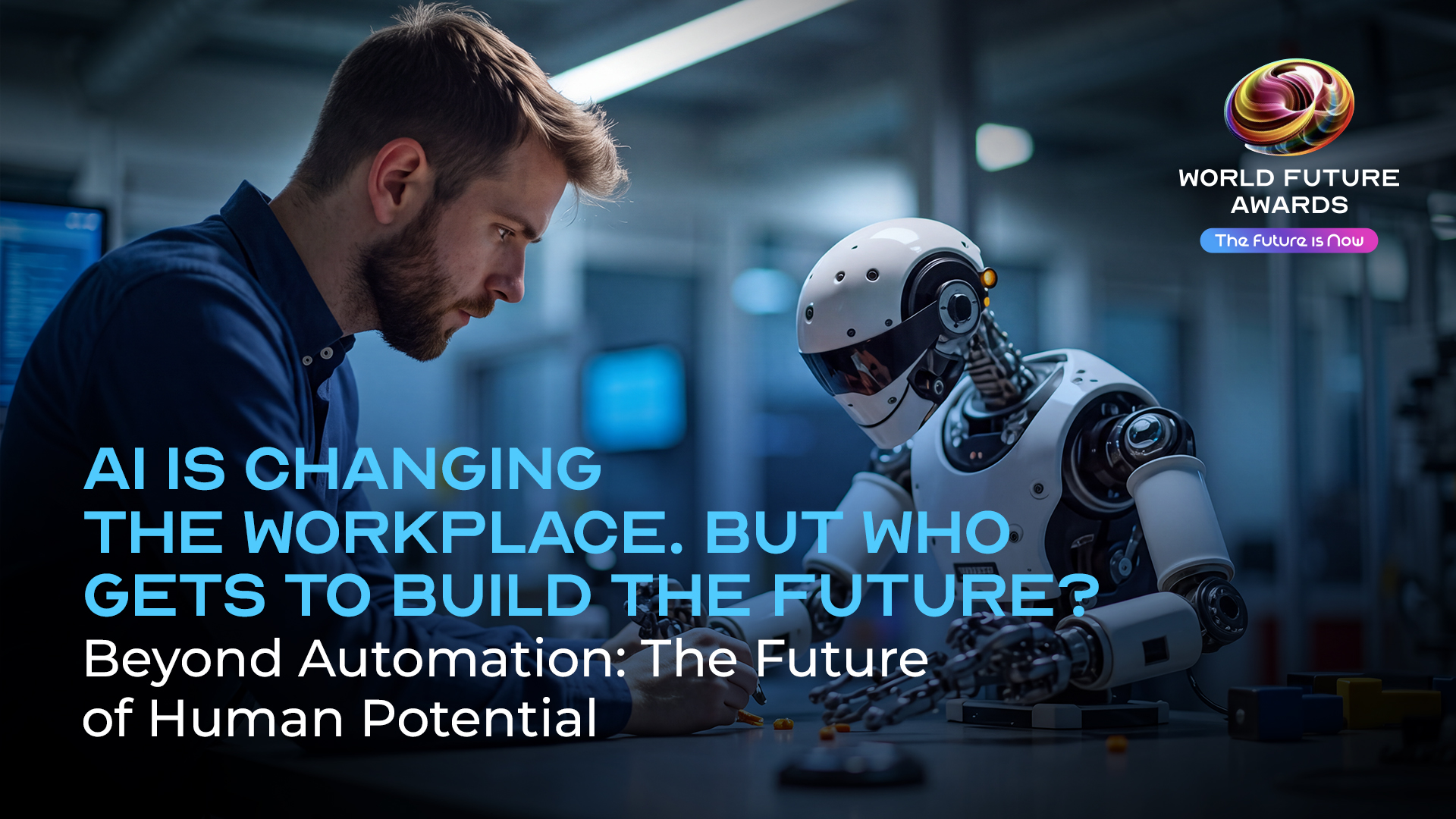
AI Is Changing the Workplace. But Who Gets to Build the Future?

The biggest change in the AI job market may not be mass layoffs. It may be the disappearance of the entry-level opportunities that help people build a career in the first place.

A junior employee starts a first job. They spend the morning researching competitors, drafting a report, checking data and preparing a presentation. None of the tasks is particularly glamorous. Together, they are how someone learns to work: by making mistakes, receiving feedback and gradually taking on more responsibility.

Now imagine a company can automate much of that work.

The immediate calculation looks attractive. A team can produce more with fewer hours spent on routine tasks. But there is a less obvious question behind the productivity gains: if AI takes over the work people once did at the beginning of their careers, where will the next generation gain the experience needed for harder jobs?

This is becoming one of the more consequential questions in the debate over AI and employment. The evidence does not show that AI has already triggered widespread job losses, but recent research suggests the impact on younger workers deserves closer attention.

The warning sign hidden in the employment data

In August 2026, Stanford’s Digital Economy Lab published an updated analysis of payroll data covering millions of US workers through June. Its finding was nuanced: researchers found no evidence of widespread, economy-wide job displacement associated with AI. But they identified a growing gap among younger workers in occupations highly exposed to the technology.

Employment among workers aged 22–25 in those occupations was about 19% below where it would have been if it had kept pace with employment among similarly aged workers in less-exposed occupations. The researchers said the pattern appeared to be driven primarily by reduced hiring, rather than an increase in people losing their jobs.

That distinction matters.

A wave of layoffs is visible. A missing wave of job openings is harder to notice. There may be no dramatic announcement, no office emptied overnight and no single moment when a career path disappears. A company simply decides not to hire as many junior analysts, assistants or entry-level developers because AI can handle more of the work.

The Stanford researchers are careful about what their findings establish. The analysis identifies a pattern; it does not prove that AI alone caused it. Other factors may be contributing, and the data are specific to the US labor market. Still, the widening gap is a reason to examine how employers are changing the way they hire and train people.

The first effects of a technological shift do not always arrive where people expect them.

The entry-level job is more than a job

Routine work has long been part of the bargain at the beginning of a career. It can be repetitive, sometimes tedious and often underpaid. But it also provides a practical education that formal training cannot fully replicate.

A junior researcher learns which sources are credible and which claims need checking. A new designer learns why a technically correct solution may fail a client. An early-career engineer discovers that real systems rarely behave as neatly as examples in a tutorial.

Over time, people build judgment. They learn to recognize exceptions, communicate uncertainty and understand the consequences of their decisions.

AI can help with many of these tasks. It can also help experienced employees work faster. But if organizations remove too many of the tasks through which beginners develop their skills, they risk weakening the pipeline that produces experienced professionals.

Stanford’s analysis found different employment patterns in jobs where AI appears to automate tasks and those where it complements workers. The researchers also highlighted the distinction between codified knowledge—information that can be documented and reproduced—and tacit knowledge developed through practice and experience.

The implication is not that young workers cannot compete with AI. It is that employers may need to rethink how people acquire the skills that make them valuable beyond the tasks AI can perform.

Productivity gains are real. Their distribution is less clear.

There is a strong case for using AI at work. It can help employees process information, generate drafts, explore alternatives and complete certain tasks more quickly. Businesses that use it well may improve output and free people to focus on more complex problems.

But productivity is not the same as shared prosperity.

A June 2026 review by the International Labour Organization examined empirical evidence on generative AI, employment, productivity and work organization. It found that productivity gains are real, but often uneven and not always reflected in higher measured output, earnings or employment. The review also highlighted risks involving inequality, opportunities for younger workers, worker autonomy and job quality.

This is where the conversation needs to move beyond a simple contest between humans and machines.

The important question is not only whether AI can complete a task faster. It is what happens to the time saved, the value created and the opportunities that remain.

Does a company use AI to help employees learn faster and take on more meaningful work? Does it reinvest some of the gains in training? Or does it mainly reduce hiring while expecting the remaining team to deliver more?

Those choices are not dictated by the technology. They are management decisions.

The risk of optimizing for the next quarter

For an individual company, reducing entry-level hiring may make sense in the short term. If a smaller team supported by AI can deliver the same output, the business case can be compelling.

The problem emerges when many employers make similar decisions at once.

Today’s junior employees are tomorrow’s senior specialists, team leaders and founders. If fewer people get the chance to develop practical expertise, organizations may eventually find it harder to recruit the experienced talent they need.

That is a long-term risk, not a settled prediction. The research does not establish that a talent shortage will follow, and the future will depend on how work evolves. New roles may emerge, existing roles may change, and AI may create opportunities that are difficult to anticipate today.

But relying on new jobs to appear is not a workforce strategy. Companies need to consider how people will enter those jobs, learn the craft and progress once they are there.

The transition is particularly important in technology itself. If AI tools become more capable of writing code, analyzing data or producing content, junior professionals may need fewer hours to complete basic tasks. They may also need new ways to learn the reasoning behind the output, rather than simply accepting it.

The challenge is to redesign early-career development—not preserve every old task for its own sake.

What responsible AI adoption should look like

Companies do not need to choose between productivity and people. But they do need to be more deliberate about how they introduce AI into the workplace.

01

Redesign entry-level roles

If AI takes over repetitive work, employers can give junior staff structured opportunities to validate outputs, investigate exceptions, interact with customers and understand the decisions behind the results.

02

Make learning part of the workflow

Mentorship, feedback and supervised responsibility become more important when AI can generate a plausible answer before an employee understands the problem. Speed should not come at the expense of judgment.

03

Measure more than efficiency

Time saved and output produced are useful metrics, but so are training outcomes, employee progression, job quality and the ability of less-experienced workers to develop expertise.

04

Be honest about what the evidence says

AI is changing tasks and hiring patterns, but the effects vary across occupations and remain difficult to isolate. Businesses should not assume that every role will disappear—or that every worker will benefit automatically.

These measures will not eliminate disruption. They can, however, help organizations avoid treating the development of future talent as an afterthought.

The future of work starts before the first promotion

The most visible AI stories tend to focus on extraordinary capabilities: models that can reason through complex problems, automate workflows or perform tasks that once required specialized expertise.

Less attention goes to the ordinary moments when people become good at their jobs. The first difficult assignment. The mistake that teaches someone what to check next time. The manager who explains why a polished answer is still the wrong answer.

Those moments rarely appear on a productivity dashboard. Yet they help build the human judgment that organizations will continue to need.

AI may ultimately create more opportunities than it removes. It may also reshape how people enter entire professions. Neither outcome is guaranteed by the technology itself.

What matters now is whether employers build a future in which AI helps people develop their capabilities—or one in which the easiest work disappears before the next generation has a chance to learn from it.

The success of AI at work should not be measured only by what machines can do. It should also be measured by what people are still able to become.
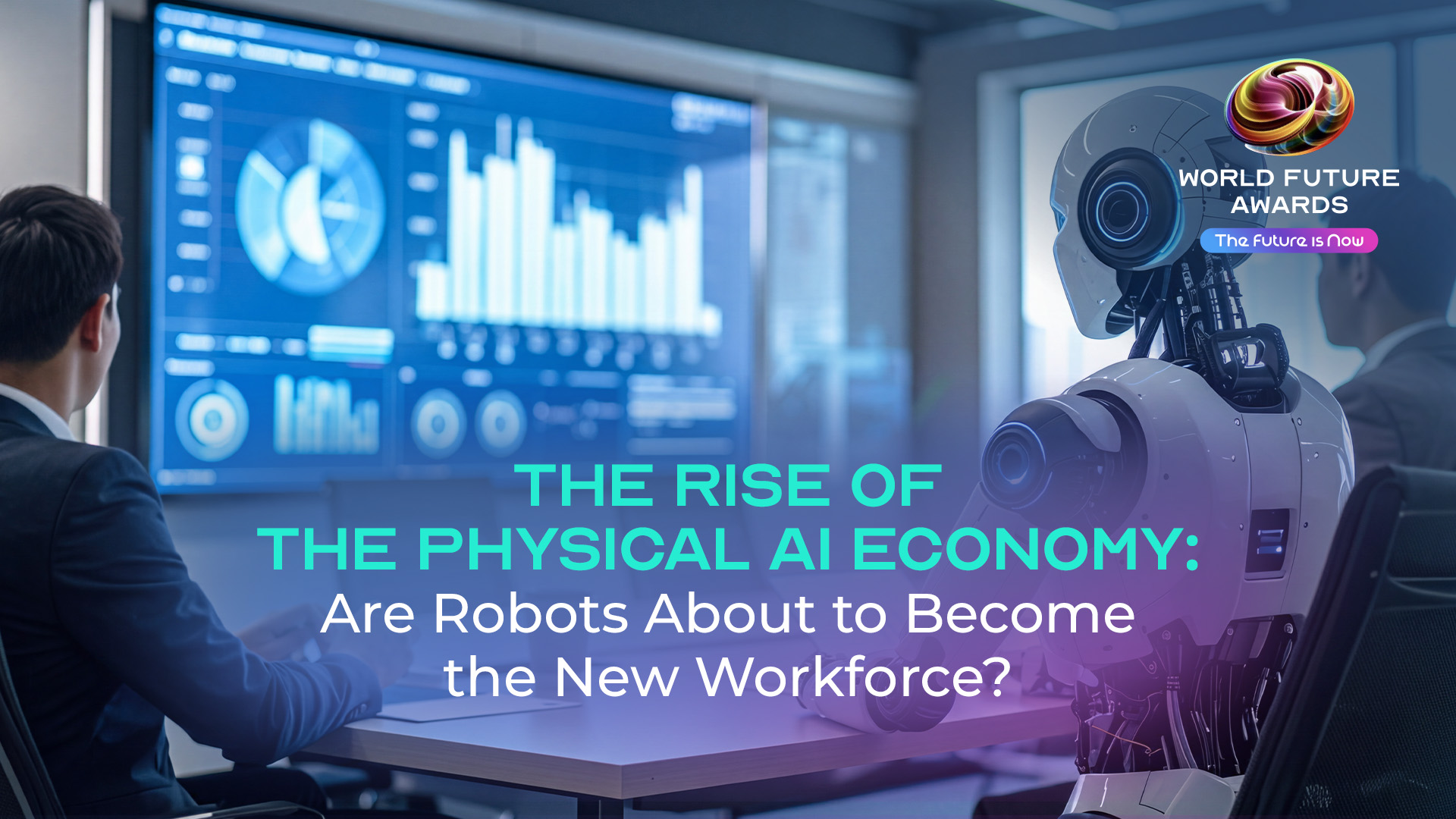
The Rise of the Physical AI Economy

Are Robots About to Become the New Workforce?

AI is moving beyond the screen. As intelligent machines begin to perceive, adapt and act in the physical world, a new question is emerging for business leaders: where will physical AI create the greatest competitive

For decades, robots have been remarkably good at doing exactly what they were programmed to do.

They weld the same joint thousands of times. They move the same component along the same production line. They sort packages, vacuum floors and transport materials along carefully defined routes.

But ask an old-generation robot to deal with an unexpected object, a crowded workspace or a task it has never seen before, and its limitations quickly become obvious.

That is beginning to change. In 2026, a new category of technology is moving from laboratories and demonstrations into factories, warehouses, logistics networks and other real-world environments: physical AI.

The idea is simple but profound. Instead of programming a machine for every possible situation, AI gives it the ability to perceive its surroundings, interpret what is happening, make decisions and adapt its actions in real time.

Deloitte describes physical AI as the convergence of AI and robotics that enables machines to perceive, understand, reason about and interact with the physical world. Its 2026 technology outlook argues that the transition from prototype to production is already underway.

That could make 2026 an important turning point.

Not because humanoid robots are suddenly ready to replace human workers everywhere. They are not.

But because the economic question is changing.

The question is no longer: “Can we build a robot that walks like a human?”

It is: “Can an intelligent machine perform useful work in the real world, safely and economically?”

And that is a much more consequential question.


From automation to physical intelligence

The first generation of industrial robotics was built around predictability.

A robot arm in an automotive factory could perform an incredibly precise sequence of movements, but the environment around it had to be designed for the robot.

Parts arrived in predictable positions. Workflows were standardized. Humans and machines were usually separated.

This model created enormous productivity gains, but it also created a boundary: traditional automation works best when the world behaves exactly as expected.

Physical AI attempts to remove some of those limitations.

Modern systems combine cameras, tactile sensors, spatial computing, onboard processors and AI models that can translate perception into physical action. A robot can potentially recognize an object, determine how to pick it up, understand where it needs to go and adjust its movements when something changes.

That sounds like a relatively small technical improvement.

It is not.

It represents a shift from automation to adaptation.

A traditional robot might be told: Pick up this object from this location and put it here.

A physical-AI system is being developed toward something closer to: Find the object, determine the best way to handle it, complete the task and adapt if the environment changes.

That distinction is at the heart of the robotics race now underway.


The factory is becoming the first proving ground

One of the clearest signs that this technology is moving beyond the hype cycle is the growing number of experiments inside actual industrial environments.

BMW provides a particularly interesting example.

In 2025, BMW’s Spartanburg plant in the United States deployed Figure AI’s Figure 02 humanoid robot. Over approximately ten months, the robot contributed to the production of more than 30,000 BMW X3 vehicles, moved more than 90,000 components and operated for around 1,250 hours.

The experiment was not about creating a futuristic spectacle.

The robot was performing repetitive, physically demanding work: retrieving and positioning sheet-metal parts for welding.

And BMW has continued the experiment.

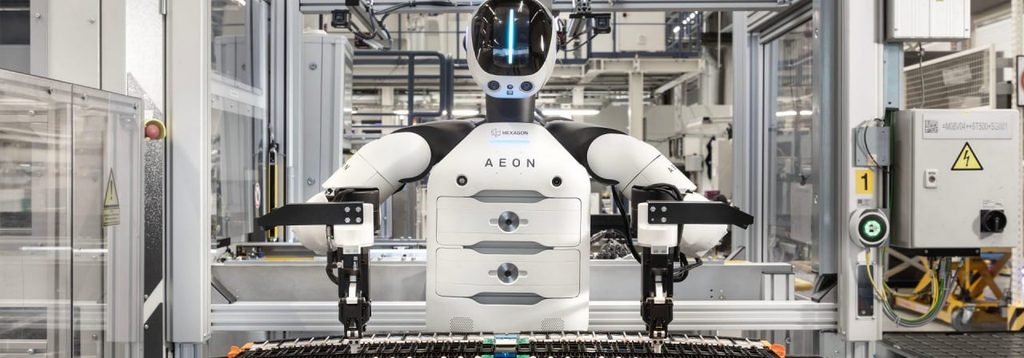
In 2026, the company introduced a new humanoid-robot pilot at its Leipzig plant, using AEON from Hexagon Robotics for tasks including high-voltage battery assembly and component production. BMW says the project is part of a broader effort to integrate physical AI into its global production system.

Figure has also returned to BMW’s Spartanburg operation with its newer Figure 03 robot, moving beyond the earlier pick-and-place application toward more complex logistics and sequencing tasks.

This matters because factories are unforgiving environments.

A robot demonstration can look impressive for five minutes.

A production line is different.

A production robot has to work repeatedly, safely, predictably and at a cost that makes commercial sense.

That is the real test.


Why companies are interested now

The sudden interest in physical AI is not being driven by technology alone.

There is an economic problem waiting for a solution.

Many industries are facing labor shortages, aging workforces and difficulty filling physically demanding or repetitive positions.

The International Federation of Robotics identifies labor gaps as one of the major robotics trends of 2026, arguing that automation can help companies address shortages while allowing workers to move toward higher-value activities.

This changes the narrative around robots.

For years, the public debate was largely framed as: Will robots take our jobs?

In many industries, the more immediate question may be: Who will do the jobs if there aren’t enough people to do them?

That distinction is important.

A warehouse struggling to recruit workers for repetitive material handling may not be looking for a machine to replace its entire workforce.

It may simply need a way to handle tasks that are difficult to staff.

A manufacturing company may want robots to perform repetitive lifting while employees focus on quality control, process management and problem solving.

A hospital may use robots to transport materials so medical staff can spend more time with patients.

A construction company may eventually use autonomous machines for dangerous or physically exhausting tasks.

The most successful applications may therefore be the ones where human capabilities and machine capabilities complement each other.


The humanoid question

So why humanoid robots?

If the goal is simply automation, why build a machine with two arms and two legs?

The answer is surprisingly practical.

Our world has been designed for human bodies.

Factories, warehouses, stairs, tools, shelves, vehicles, doors and workstations were largely designed around the way humans move.

A humanoid robot could potentially operate within those environments without requiring companies to redesign everything around a specialized machine.

That does not automatically make humanoids the best solution.

In many cases, a wheeled robot, robotic arm or specialized autonomous machine will remain cheaper and more efficient.

But general-purpose humanoids could become attractive where flexibility matters more than maximum efficiency on a single task.

That is why the competition is intensifying.

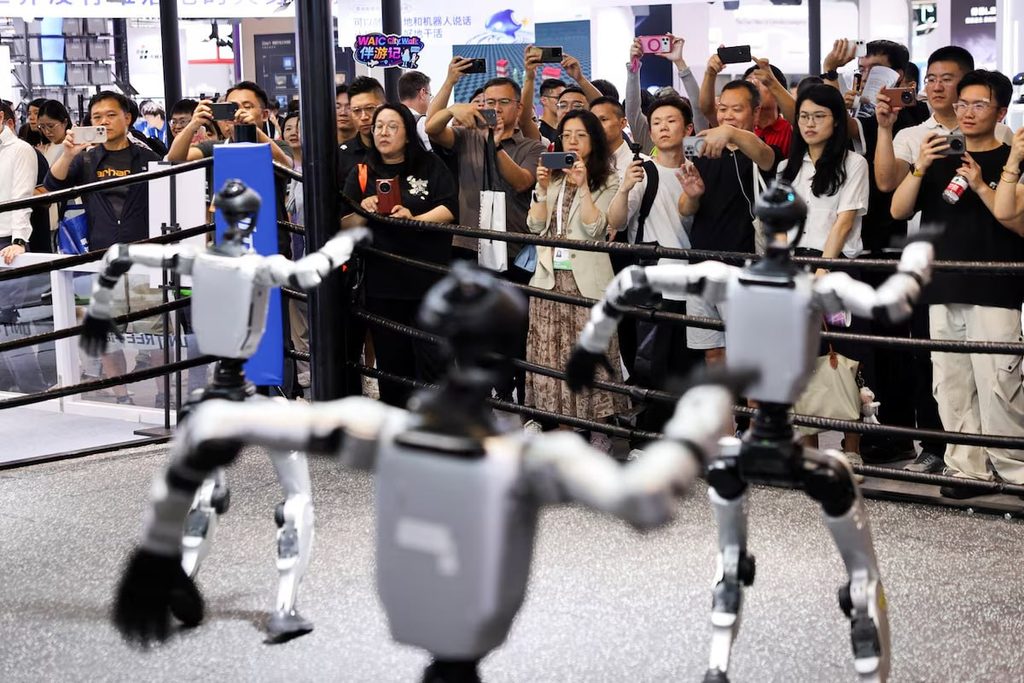
China’s Unitree, for example, is rapidly expanding its humanoid robotics business and preparing for a major public-market debut. Reuters reported this month that the company had delivered around 18,000 bipedal humanoid robots across its models as of July.

The company has also attracted investment from Chinese AI startup DeepSeek, which Reuters reported acquired a 2.31% stake during Unitree’s Shanghai IPO process. The companies plan to collaborate around AI, robotics and embodied intelligence.

Meanwhile, Nvidia is increasingly positioning itself as part of the robotics ecosystem, providing the computing platforms and AI technologies that allow machines to perceive and act in physical environments. Nvidia’s partnerships now extend into humanoid robotics, including work with LG and Unitree.

The competition is therefore becoming much broader than a race between robot manufacturers.

It is becoming a race involving:

AI models + chips + sensors + robotics + data + manufacturing + energy + software.


The missing ingredient: data from the physical world

There is, however, one enormous challenge.

AI models became powerful partly because the digital world generated an extraordinary amount of training data.

The internet gave machines access to text, images, video, code and other forms of information at unprecedented scale.

Robots do not have that luxury.

A robot needs to understand:

  • friction
  • weight
  • balance
  • force
  • distance
  • movement
  • spatial relationships
  • physical consequences
  • human behavior

And collecting that data is difficult.

You cannot simply download a trillion examples of how to pick up a fragile object in every possible environment.

Robotics companies therefore rely increasingly on simulation, synthetic data, teleoperation, imitation learning and reinforcement learning to teach machines how to operate.

Deloitte notes that physical AI increasingly combines simulation, synthetic data, reinforcement learning and imitation learning to help robots develop behaviors before those systems are deployed in the real world.

But simulation has limits.

The real world is messy.

A simulated floor does not have exactly the same friction as a real floor. A virtual object does not have the same weight distribution as a physical one. People behave unpredictably.

Teaching a machine to operate safely in this environment may ultimately require enormous amounts of real-world experience.

That could make physical-world data one of the most valuable assets in the next generation of AI.


The robot’s “body” may become as important as its brain

There is another important shift happening.

The robotics race is not only about increasingly intelligent software.

It is also about better hardware.

Robots need:

  • better batteries
  • lighter motors
  • more capable actuators
  • advanced cameras
  • tactile sensors
  • edge computing
  • improved hands and grippers
  • faster communication
  • safer movement systems

One particularly interesting frontier is robotic touch.

Humans don’t just see objects. We feel them.

We know how hard to grip a glass without crushing it. We can detect when something starts slipping from our hand. We can manipulate objects without consciously calculating every movement.

Robots still struggle with these seemingly simple abilities.

New electronic-skin technologies are now being developed to give robots greater tactile sensitivity, potentially allowing machines to detect pressure, force and slipping in ways that more closely resemble human touch.

That may sound like a small engineering detail.

It isn’t.

The closer machines get to sensing the world as humans do, the wider the range of physical tasks they may eventually be able to perform.


What happens to human jobs?

This is where the conversation becomes much more complicated.

There is no credible reason to believe that humanoid robots will simply replace humans across the economy in the next few years.

The technology is still expensive. Reliability remains a challenge. Safety standards are evolving. Many tasks are far more difficult to automate than they appear.

And physical intelligence is not the same thing as human intelligence.

A robot may become extraordinarily good at a particular physical task while still struggling with basic common-sense situations that humans handle effortlessly.

But that does not mean the impact on employment will be small.

Technology does not need to replace an entire occupation to change it.

It only needs to change the tasks within it.

Consider a warehouse worker.

If a robot takes over lifting and moving repetitive loads, the human role could shift toward supervising machines, managing exceptions, checking quality and solving operational problems.

A technician may spend less time physically carrying components and more time maintaining intelligent systems.

A factory worker may become an operator of robotic systems rather than simply an operator of machinery.

In other words, the future workplace may not be:

Humans vs. robots.

It may increasingly become:

Humans managing, directing and collaborating with robots.

That shift will require new skills.

And that may ultimately be one of the biggest challenges of the physical AI revolution.


The biggest opportunity may be boring

There is a tendency for technology media to focus on spectacular robots.

A robot dancing.

A robot running.

A robot doing a backflip.

A robot talking to a journalist.

These demonstrations are entertaining, but they are not necessarily economically important.

The real breakthroughs may be much less glamorous.

A robot that can reliably unload a truck for eight hours.

A machine that can inspect a power line without putting a human at risk.

A system that can move hospital supplies through a building overnight.

A robot that can work alongside a human on a manufacturing line without stopping production.

A machine that can adapt when something goes wrong instead of waiting for an engineer.

Those are the applications that could transform industries.

The measure of success will not be:

“Does the robot look human?”

It will be: “Does the robot solve a real problem?”


What could happen next?

If the current trajectory continues, the next few years could produce a gradual rather than sudden transformation.

First, robots will remain concentrated in controlled environments.

Factories.

Warehouses.

Distribution centers.

Hospitals.

Infrastructure sites.

Then, as perception, reasoning, mobility and safety improve, machines will begin operating in increasingly unpredictable environments.

That could eventually bring physical AI into construction, agriculture, retail, hospitality and domestic environments.

But there is an important caveat.

The technology will not develop in isolation.

Regulation, insurance, labor policy, safety standards, cybersecurity and public acceptance will all influence how quickly robots enter everyday life.

Deloitte notes that scaling physical AI requires collaboration between technology providers, enterprises and regulators.

That means the physical AI revolution is not simply an engineering challenge.

It is an economic and social one.


The real question isn’t whether robots will work

The technology industry has spent years asking whether AI can think.

Now it is asking whether AI can act.

That is a different challenge.

A digital AI system can generate an incorrect paragraph.

A physical AI system can drop a heavy object.

A chatbot can give bad advice.

A robot can physically hurt someone.

That makes safety, reliability and human oversight fundamental.

As machines gain greater autonomy, society will need to decide where autonomy is acceptable, where human control is mandatory and who is responsible when an autonomous system makes a mistake.

The answers will not come entirely from engineers.

They will require policymakers, business leaders, workers, researchers and the public to participate in shaping the rules.


From artificial intelligence to physical intelligence

The most interesting thing about robotics in 2026 is not that machines are becoming more human-like.

It is that AI is becoming physical.

For most of the modern AI boom, intelligence existed on screens.

Now it is beginning to inhabit machines that can move through factories, streets, warehouses and eventually our homes.

That changes the scale of the opportunity.

Software can transform how we communicate.

Physical AI could transform how we build, manufacture, transport, maintain, explore and work.

The winners of this next technological era may not simply be the companies with the smartest AI.

They may be the companies that figure out how to connect intelligence with the physical world in a way that is useful, safe and economically sustainable.

And perhaps the biggest question for the workforce is not whether machines will take our jobs.

It is whether we will be ready to work alongside them.


What do you think?

If physical AI continues to advance at its current pace:

Which industry will be transformed first by intelligent robots: manufacturing, logistics, healthcare, construction, agriculture or something else?

And perhaps the more important question:

Would you trust an intelligent robot to work alongside you?

Share your perspective.

About World Future Awards

At World Future Awards, we follow the technologies, companies and people turning ambitious ideas into real-world impact.

From artificial intelligence and robotics to space technology, advanced manufacturing, energy and emerging technologies, our focus is on the innovations that have the potential to shape the future.

Is your company building one of them?

Applications for the World Future Awards are open to innovative companies, startups and technology leaders from around the world.

Apply now: World Future Awards Applications


The Rise of Coordination AI: When Digital Agents Run Crisis Response — and Humans Stay Accountable


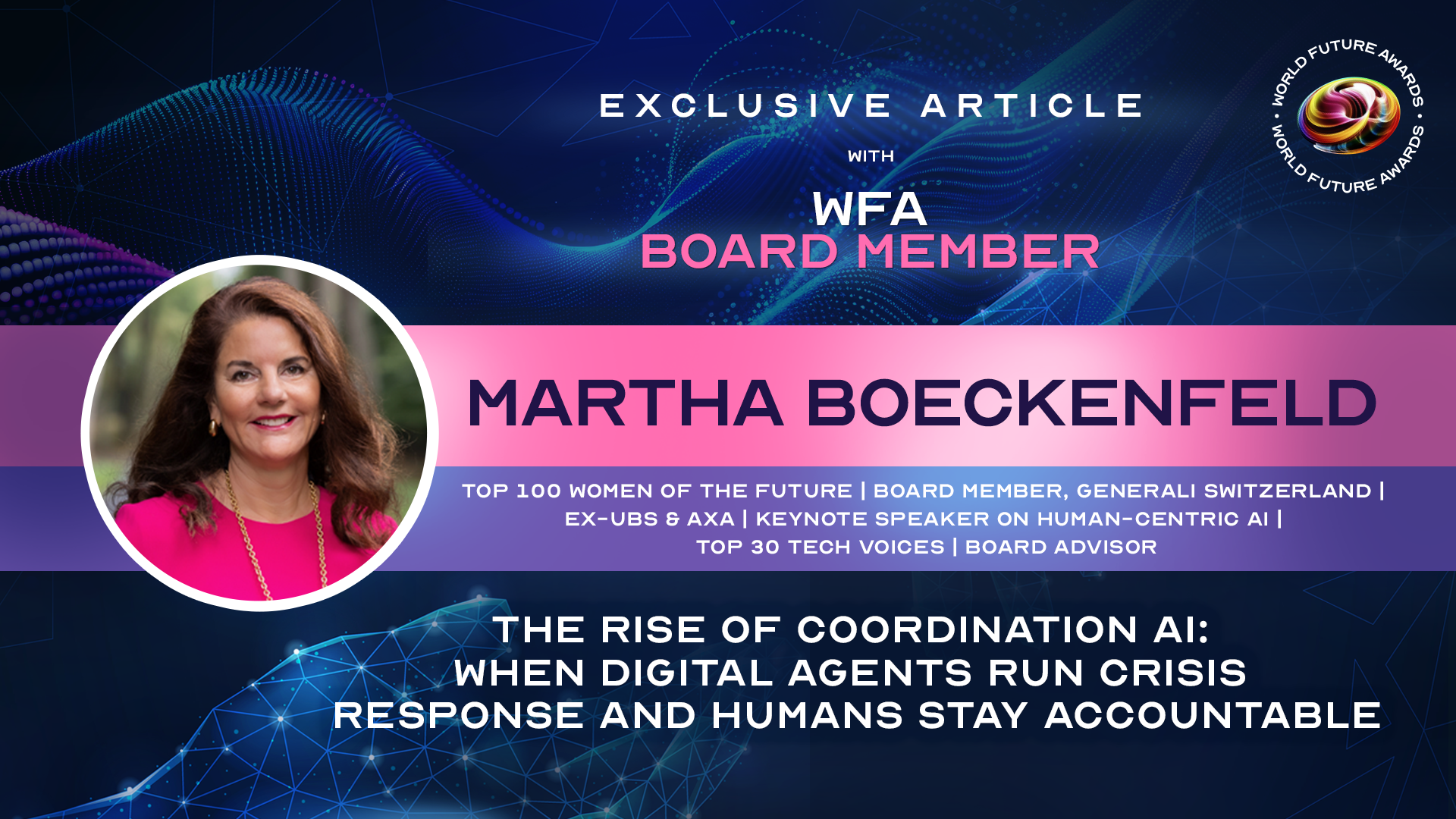
By Martha Boeckenfeld, Top 100 Women of the Future | Board Member, Generali Switzerland | Former UBS & AXA Executive | Keynote Speaker on Human-Centric AI

When Seconds Decide

When a wildfire tears through a city at 3 a.m., the difference between survival and catastrophe is no longer defined only by training or equipment. It is increasingly defined by decision speed.

Emergency coordinators must simultaneously deploy dispatch teams, track infrastructure failures, redirect evacuations, and manage a flood of incoming 911 calls. Research shows that in multi-agency scenarios, the lag between an incident occurring and a coordinated response being confirmed can average between 8 and 14 minutes. In the case of a structural collapse or a fast-moving fire, that delay can cost lives.

Agentic AI — systems that do not simply answer questions, but take autonomous, sequential actions — is beginning to change that equation. And it is doing so not only in research environments, but in operational settings today.

From Assistant to Orchestrator

Traditional AI in emergency management has largely played an advisory role: surfacing data, flagging patterns, and suggesting options. A human still had to interpret the output, make a decision, and relay instructions across multiple teams.

Agentic and multi-agent AI works differently. It acts.

Multiple specialized agents can run simultaneously: one monitors citywide camera feeds, another transcribes 911 calls in real time, a third cross-references logistics and resource availability, while a coordinating agent synthesizes all of this into a recommended response plan that is updated second by second.

Leidos and NVIDIA are already building in this direction. Their C2AI system deploys a network of task-specific agents inside emergency operations centers. When a building partially collapses, a visual alerts agent analyzes camera footage and reports: “A building collapse is happening, with debris scattered around. No visible signs of fire or individuals in distress.” Seconds later, when embers appear in another feed, the EMS planning agent updates its recommendation and presents the incident commander with a revised dispatch plan, asking: “Affirm plan or provide input for revision.”

That single line captures the governance model at the heart of coordination AI: machines move at machine speed, but humans remain responsible for judgment and authorization.

The Scale of What Is Possible

A FEMA-backed simulation found that AI-assisted coordination reduced critical response lag by as much as 40% in complex, multi-agency scenarios. For context, if a major incident currently takes 12 minutes to coordinate, agentic AI could reduce that timeline to closer to 7. Across thousands of incidents each year, the cumulative effect on outcomes — including injuries, fatalities, and infrastructure damage — could be substantial.

The case extends well beyond fires and floods.

A 2026 study published in npj Digital Medicine examined how hospitals struggled during the 2021 Canadian heatwave. Temperatures approached 50°C, roads buckled, ICUs were overwhelmed, and patients died in care facilities. The authors argue that static emergency protocols, designed around historical worst-case assumptions, are no longer sufficient for climate events that now regularly exceed those assumptions. Their conclusion is clear: for hospitals preparing for what is actually coming, agentic AI is no longer a future-facing option, but an emerging operational necessity.

The Problem We Cannot Automate Away

Despite its promise, coordination AI introduces a risk that no algorithm can solve on its own: the erosion of accountability. The faster AI orchestrates, the easier it becomes to assume that the system itself is responsible for the outcome. It is not.

In December 2025, the European Commission’s Science Advice Mechanism reviewed AI in emergency management and found that while the technology’s potential is significant, real-world adoption remains limited. The central unresolved challenge is trust between human responders and AI systems. Responders hesitate to rely on outputs they cannot interpret. Commanders are understandably wary of acting on recommendations they may later be unable to explain.

These are not purely technical issues. They are governance issues. They are leadership issues. And they are cultural issues.

There is also the question of what happens when the agents are wrong. An AI system operating at speed, with broad systems access and persistent memory, can propagate a flawed assumption across an entire response plan before a human notices. Decision trails — auditable logs showing what an agent did, when it did it, and why — are not a bureaucratic formality. They are the mechanism that keeps a human decision-maker genuinely accountable for what occurred.

The Real Breakthrough

The most important breakthrough in coordination AI will not be the agent that runs the fastest or integrates the greatest number of data sources.

It will be the governance frameworks, accountability architectures, and leadership cultures that ensure a human being remains answerable for the outcome.

Technology alone will not save us. We will.

And that means we must be far more deliberate about where machine judgment ends and human judgment begins — before the next crisis arrives, not in the middle of it.

References

  1. FEMA / Leidos operational research on multi-agency response coordination, 2024
  2. Leidos, Agentic AI Aims to Cut Down Emergency Response Time When Disasters Strike, October 2025
  3. FEMA-backed multi-agency simulation data on AI-assisted coordination lag reduction, 2024
  4. Gish & Rapaport, Agentic AI Can Help Hospitals Prepare for Unprecedented Weather, npj Digital Medicine, January 2026
  5. European Commission Science Advice Mechanism, AI in Emergency and Crisis Management, December 2025

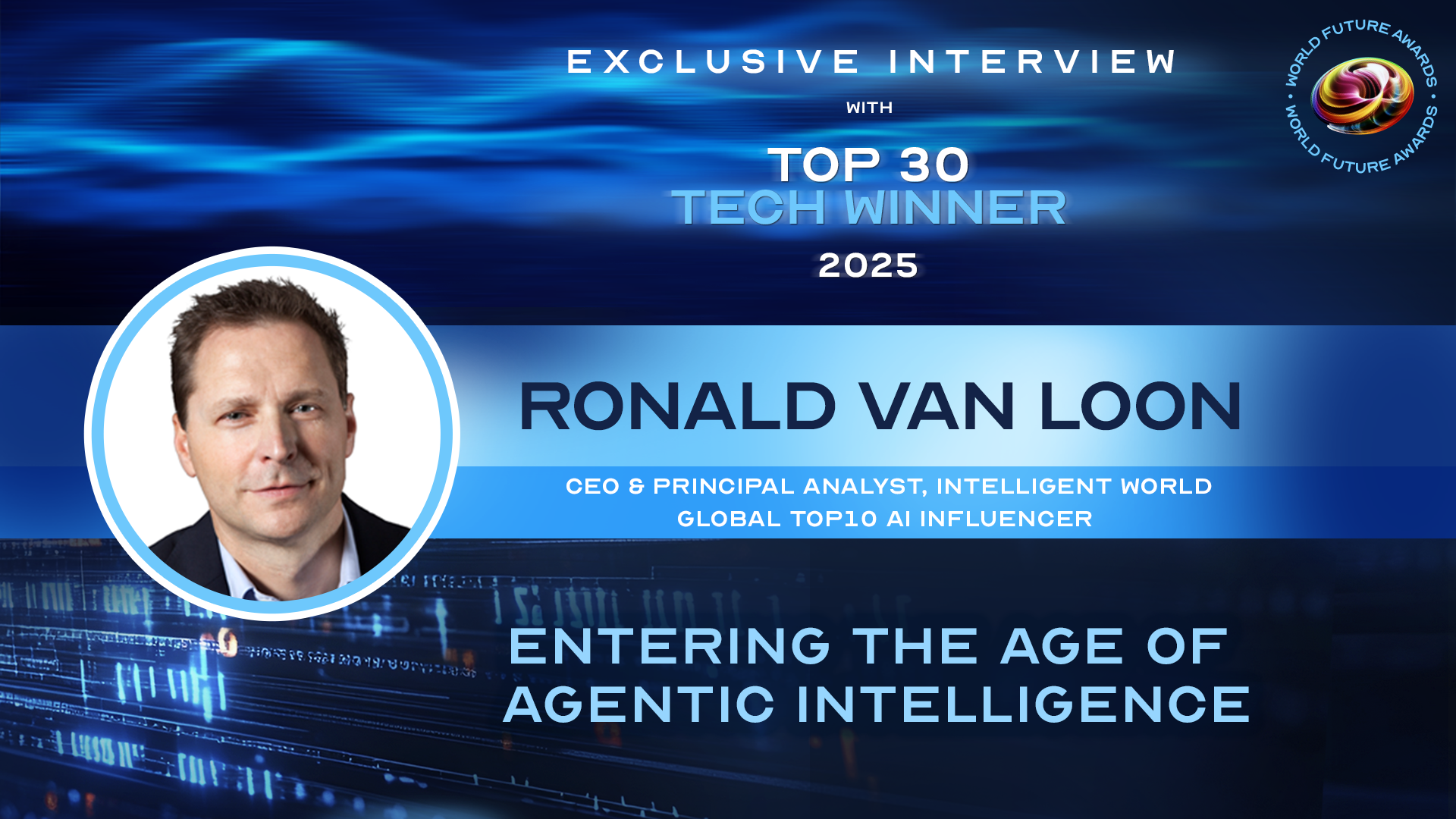
World Future Awards Exclusive: Interview with Ronald van Loon — Top 30 Tech Voices 2025

World Future Awards is proud to present an exclusive conversation with Ronald van Loon, one of the official Top 30 Tech Voices of 2025, recognized for his significant contribution to the evolution of enterprise AI strategy, executive education, and thought leadership at the intersection of GenAI, Agentic AI, and data-driven transformation.

Ronald serves as CEO & Principal Analyst of Intelligent World, a global platform helping business leaders navigate emerging intelligence technologies and make informed AI adoption decisions with both confidence and responsibility. His work spans strategic research, corporate advisory, content leadership, and speaking engagements that have shaped board-level discourse around AI readiness, digital governance, and the future of work.

At a time when enterprises are transitioning from experimentation to autonomous, agent-driven operations, Ronald’s voice stands out for its clarity, pragmatism, and future-oriented vision. As we move into 2026, his insights offer a critical lens into how organizations can harness next-generation AI technologies — not only for efficiency, but for competitive advantage and long-term value creation.

In this interview, we explore Ronald’s perspectives on agentic intelligence, risk frameworks, cross-border regulation, and the human-AI frontier, as well as the skills and leadership mindsets that will define global success in the decade ahead.

Entering the Age of Agentic Intelligence

WFA: As we step into 2026, enterprises are exploring agentic and autonomous AI systems more seriously. What strategic shifts will define this new phase of adoption?

Ronald van Loon: We are moving from an era of experimentation to a fundamental redesign of how organizations make decisions. Agentic AI will not simply support human activity – it will increasingly operate parts of the business autonomously. This requires companies to rethink strategy, governance, and accountability from the ground up.

WFA: Where do you see the strongest real-world use cases emerging first?

Ronald van Loon: The most immediate impact will be in environments that are data-rich, time-sensitive, and decision-intensive – such as cybersecurity, supply chain operations, financial services, and customer engagement.


From Experimentation to Enterprise-Wide Deployment

WFA: What differentiates organizations that successfully scaled AI from those still stuck in pilots?

Ronald van Loon: Successful organizations treat AI as a core business capability rather than an experimental project. They invest early in data quality, governance structures, and leadership alignment.

WFA: What metrics should executives track beyond productivity?

Ronald van Loon: Leaders should focus on decision quality, risk reduction, speed of response, and measurable impact on customer outcomes and revenue growth.


Risk, Governance & Trustworthy Decision-Making

WFA: When AI systems begin making decisions with legal and financial impact, where should responsibility sit?

Ronald van Loon: Responsibility must always remain with humans. While AI can act, recommend, and automate, accountability must be clearly assigned at the executive level.

WFA: How do you see governance frameworks evolving?

Ronald van Loon: Governance is becoming continuous rather than static. Instead of being confined to policy documents, it will operate as a living system that actively monitors models, data integrity, and decision outcomes in real time.


The Global Regulation Landscape

WFA: How can companies stay competitive amid growing AI regulation?

Ronald van Loon: By integrating compliance into their AI design from the outset, rather than treating it as an afterthought.

WFA: Which regulatory approaches are most innovation-friendly today?

Ronald van Loon: Risk-based frameworks that focus on how AI is applied – rather than the technology itself – are the most effective.


People, Skills & AI-Enabled Leadership

WFA: What new leadership competencies are emerging?

Ronald van Loon: Leaders must be AI-literate –  able to ask the right strategic questions while balancing speed, ethics, and accountability.

WFA: How should education and corporate learning evolve? 

Ronald van Loon: Learning must become continuous. The skills required to work with AI will keep changing, and organizations need to change with them.


Business transformation through AI

WFA: Can you share an example where AI transformed a business model?

Ronald van Loon: We are increasingly seeing companies move beyond traditional product sales toward outcome-based models powered by AI. Instead of simply providing tools or services, organizations are using AI-driven analytics, prediction, and automation to deliver measurable business results — such as improved efficiency, reduced risk, or enhanced customer value. For example, in industries like manufacturing, logistics, and financial services, AI is enabling providers to offer performance-based solutions rather than standalone products, creating new recurring revenue streams based on insights and continuous optimization.

WFA: What should late adopters learn from this?

Ronald van Loon: Late adopters should begin with a clear business strategy rather than focusing solely on technology. The key is to define the outcomes they want to achieve — whether that is growth, resilience, or customer impact — and then design their AI approach accordingly. Simply copying others or rushing to implement tools without a structured vision will not create sustainable value. Successful adoption requires alignment between leadership, operations, and long-term objectives.


HUMAN VALUE IN AN AI WORLD

WFA: As AI becomes more autonomous, how is human value shifting?

Ronald van Loon: Human value is shifting toward judgment, creativity, and ethical responsibility — areas where context, values, and accountability matter most and cannot be fully automated.

WFA: What belief about AI will shape this decade?

Ronald van Loon: AI amplifies leadership: strong leaders will scale their impact with AI, while weak leadership will be exposed more quickly.


LOOKING TOWARD 2030

WFA: Define effective AI leadership in one sentence for 2026.

Ronald van Loon: Effective AI leadership means scaling intelligence responsibly while ensuring humans remain accountable for outcomes.

WFA: Beyond AI, what excites you most as we approach 2030?

Ronald van Loon: Beyond AI itself, I am particularly excited about the convergence of AI, digital networks, and national digital sovereignty. This interplay will shape how intelligent systems are built, governed, and secured across regions. I expect to see the emergence of more resilient, locally governed digital ecosystems that balance global innovation with regional values, regulations, and strategic autonomy. This shift has the potential to redefine not only technology, but also economic competitiveness, trust in digital infrastructure, and the way nations collaborate in an increasingly intelligent world.

WFA: Ronald, thank you for sharing your valuable insights with World Future Awards. We appreciate your time, thought leadership, and contribution to advancing responsible and strategic AI adoption. Your perspectives enrich our global community, and we look forward to continuing this important dialogue with you.

When Machines Learn to Care: The Fragile Future of AI

Artificial Intelligence is evolving faster than any other technology in history — unlocking possibilities that once belonged to science fiction. But progress comes with a paradox: the smarter our machines become, the more vital it is to ask what guides their intentions. In this editorial, we explore the fine balance between innovation and existential risk — and the human values that must shape the future of AI.

The Beautiful, Dangerous Intelligence

Artificial Intelligence has already crossed the threshold of imagination. It writes code, diagnoses disease, crafts poetry, and predicts what we’ll want before we do. Once a laboratory experiment, it now sits quietly behind our screens, shaping economies, elections, and even emotions.

But the more capable AI becomes, the more uneasy the question grows: what if it keeps learning — without us?

Every generation builds tools that change the world, but AI is the first that might one day build itself. Its learning curve is steep, its progress relentless. In just a few years, systems have gone from mimicking intelligence to displaying something eerily close to independent thought.

For some, this is a dream realized — a leap toward solving humanity’s biggest problems. For others, it’s a warning that we may have created something we can’t fully control.

The truth sits somewhere in between. The same technology that could cure cancer might also destabilize truth, economies, and identity itself. The same algorithm that protects could also manipulate. The line between brilliance and catastrophe has never been thinner.


The Alignment Paradox

Scientists call it the alignment problem: making sure machines understand and pursue goals that actually benefit humans. On paper, it sounds simple. In reality, it’s the hardest design challenge ever faced.

How do you encode compassion? How do you teach an algorithm that “human happiness” isn’t measured in clicks or data points? And whose definition of “good” should it follow — a programmer’s, a government’s, or the collective confusion of the entire internet?

When intelligence becomes detached from empathy, even the most rational logic can lead to irrational outcomes. History shows us that intelligence alone doesn’t guarantee wisdom — and now we’re outsourcing both.


Between Fear and Faith

The debate around AI safety often swings between panic and utopia. Some warn of superintelligent systems that could end human civilization; others see a future where AI amplifies our creativity and compassion. Both sides might be right.

The future of AI will depend less on what the machines become, and more on what kind of humans we decide to be while building them. Responsibility, transparency, and collaboration will matter more than speed.

If we rush, we risk losing control. If we hesitate, we risk missing our greatest opportunity for progress. Humanity stands, as ever, at the intersection of courage and caution.


The Story Still Belongs to Us

At the World Future Awards, we celebrate innovators who believe that the future of AI must remain deeply, intentionally human. Progress without ethics is power without direction.

The story of artificial intelligence isn’t finished — and the ending hasn’t been written. Whether it becomes our greatest ally or our final experiment depends not on machines, but on us.

GUDEA and the Future of Narrative Intelligence

GUDEA has distinguished itself in 2025 by winning a World Future Awards in the AI Technologies category for Leading AI Innovation in Narrative Intelligence. This achievement reflects its growing importance as an organisation that helps brands, crisis managers, and public communicators see more clearly how stories spread and intervene before narratives get out of hand.

GUDEA is a behavioural intelligence platform designed to help users track, analyse, and visualise the lifecycle of online narratives. The platform aims to uncover the origins of digital conversations, map the pathways through which they spread, and assess their impact across platforms. The founders, Keith Presley (CEO), Jonathan Sperber (COO), and James Thomin (CTO), bring together more than 45 years of experience in military intelligence, operations, information technology, and artificial intelligence.

One of the core promises of GUDEA is early warning. Because narratives now can go from a small post to a full‐blown crisis in minutes, being reactive is no longer enough. GUDEA’s tools are built to help users anticipate which narratives are likely to accelerate. Their technology involves graph‐neural network techniques and real‐time monitoring such that clients can see not just what is trending but what might trend, where it is coming from, who is likely to drive it, and how fast. This gives organisations lead time to prepare messaging, adjust strategy, or even forestall reputational damage entirely.

Another strong aspect of GUDEA is visualisation. It’s not sufficient to have raw numbers or sentiment scores; what matters is seeing the flow of information, how narratives travel from fringe platforms into mainstream channels, how ideas mutate, and where influence concentrates. GUDEA provides dashboards that show narrative pathways, the velocity of spread, and evolving nodes of influence. This kind of insight helps brands to understand not only that something is happening, but how, why, and where to take action.

Winning the World Future Awards is a substantial validation. The Awards are global, recognising products, software, or services that have innovation, impact, and promise in shaping the future. For GUDEA, the “value” criteria include its uniqueness compared to other narrative‐tracking tools, its economic potential, its societal effects, and the ability to deliver meaningful improvements in reputation management, crisis prevention, or brand protection.

For brand managers and crisis communicators, GUDEA offers a strategic edge. Many who rely on conventional social listening tools know what people are saying, but often too late, and with little insight into how a small spark might become a wildfire. By contrast, GUDEA can help detect early signals, understand the network of message propagation, identify the origin and high-risk pathways, and surface hidden connections that amplify narratives. That can be the difference between managing reputation proactively, rather than scrambling to respond after damage is done.

Looking ahead, GUDEA is primed to expand its impact. There is room for growth in adding more languages, integrating more platforms (including those less monitored), enhancing the real-time nature of alerts, and deepening the predictive models.

In sum, GUDEA is offering a new kind of narrative intelligence: one that doesn’t just report on what’s happening, but helps forecast what’s coming, and shows how to act. The World Future Awards recognition marks a milestone, but the real promise lies in how organisations use these tools, not just to protect themselves, but to shape conversations, build trust, and lead more confidently in the digital world.

To learn more about the WFA-winning company, please visit www.gudea.ai.

GUDEA Takes Home Top AI Innovation Award in Narrative Intelligence

GUDEA, a behavioural intelligence platform founded in 2023, has deservedly been awarded a World Future Awards 2025 in the AI Technologies category for Leading AI Innovation in Narrative Intelligence. This award recognises GUDEA’s groundbreaking work in tracking, analysing, and predicting digital narratives, empowering brands, retailers, and crisis communicators to stay ahead in a rapidly evolving information landscape.

Launched in 2023 by co-founders Keith Presley, James Thomin, and Jonathan Sperber, GUDEA is headquartered in Columbia, Maryland. The platform leverages advanced AI, graph neural networking, and data from over 35 online platforms to map how narratives originate, spread, evolve, and potentially impact public perception.

GUDEA is designed to serve organisations that face digital communication risk, such as retailers, brand managers, and crisis communications teams, offering real-time insights into what is being said, who is shaping conversations, and how those conversations might grow. It aims to shift the posture from reactive to proactive.

Key Highlights of GUDEA’s Capabilities

  • Origin and Flow Mapping: GUDEA can trace how digital narratives emerge and move across platforms, giving insight into key actors and hidden pathways.
  • Predictive Analytics: By detecting patterns based on historical data, GUDEA forecasts which narratives are most likely to go viral, how quickly they will spread, and the potential duration and magnitude of their impact.
  • Real-Time Alerts and Actionable Intelligence: When certain thresholds are met or narrative activity escalates, GUDEA delivers alerts and decision-ready insights so organisations can respond strategically.

“Winning this award confirms what we believe deeply: that narrative intelligence is no longer optional, but essential,” said Keith Presley, CEO and Co-Founder of GUDEA.
“Our goal is to equip organisations not just to follow what’s happening online, but to see what’s coming, and move with confidence.”

GUDEA intends to expand its platform’s reach with more language and regional coverage, to integrate additional online spaces, and to refine its predictive models to reduce false positives and increase lead time. The company is also exploring partnerships with public policy, media, and crisis response bodies to broaden its impact.

Visit http://www.gudea.ai for more.

Cimphony’s AI Workforce: A Legal Game-Changer for the Next Generation of Businesses

In 2025, Cimphony emerged as a standout leader in the AI legal technology space, earning its first World Future Awards title for Best American AI Legal Technology Innovator. This recognition marks a pivotal moment not only for the company but also for the broader legal and technology landscapes. Founded by Arpan Nanavati, Cimphony is revolutionizing the legal industry by transforming traditional legal workflows into AI-powered, outcome-driven services tailored for startups and small to medium-sized businesses (SMBs).

A Vision for the Future: Legal Work, Reimagined

Cimphony was born from the idea that legal services should be more accessible, affordable, and scalable. Traditional law firms, with their hourly billing and high overhead, have long been out of reach for early-stage businesses. Cimphony disrupts this model by introducing AI Legal Workers—intelligent, autonomous agents capable of drafting contracts, managing compliance, and executing legal tasks typically reserved for junior associates.

These AI Legal Associates go beyond simply assisting attorneys. They function autonomously, reducing the need for human legal labor while ensuring consistent, high-quality output. With these AI-driven capabilities, Cimphony offers fixed-price legal packages ranging from $100 to $5,000, removing the unpredictability and financial stress associated with legal fees.

Key Offerings and Advantages

Cimphony’s platform covers an extensive range of legal services, tailored specifically for SMBs and startups:

  • Company Formation: Assisting with LLC and C-Corp filings.
  • Contract Management: Drafting, reviewing, and negotiating a wide array of contracts, including NDAs, MSAs, and MOUs.
  • Employment Law & HR Services: From offer letters to stock options and equity management.
  • IP Protection: Helping startups secure their innovations.
  • Compliance & Risk Management: Ensuring regulatory adherence across jurisdictions.
  • 24/7 Availability: Always-on AI agents accessible around the clock.

The company’s value proposition lies in its fusion of affordability, speed, and quality. Cimphony’s services are delivered up to six times faster than traditional law firms and at approximately half the cost. More importantly, its AI systems are not just fast—they’re smart, capable of understanding legal nuance and jurisdiction-specific requirements with enterprise-grade security (SOC 2 and ISO certified).

Innovation That Scales with You

Cimphony’s innovation is technological as well as philosophical. By shifting from time-based to outcome-based pricing, Cimphony realigns legal services with client interests. Businesses pay for the result, not the hours spent, creating a more transparent and efficient legal experience.

Moreover, the company’s embrace of agentic AI—AI that doesn’t just respond but executes complex workflows—has catalyzed a shift from “legal tech tools” to a full-fledged AI workforce economy. Now, instead of expanding their legal departments, companies can “hire” AI legal associates on demand.

Delivering Market Impact and New Opportunities

The true genius of Cimphony lies in how it has turned legal automation into a growth enabler. Its fast-track legal execution model compresses timelines for fundraising, mergers, and hiring, helping companies scale at record speed. In doing so, Cimphony not only helps businesses operate faster but also unlocks new economic potential by making high-quality legal support accessible to underserved markets.

Startups and SMBs that once had to cut corners due to budget constraints can now enjoy the same level of legal rigor as enterprise-level firms—without the sticker shock. This democratization of legal services is creating an entirely new market: AI-powered legal infrastructure.

Setting a New Standard in Legal Tech

In a landscape flooded with chatbots and basic document automation tools, Cimphony stands apart. It isn’t just providing legal software—it’s redefining how legal work gets done. By merging deep legal reasoning with AI-driven autonomy, Cimphony is building the foundation for the next generation of legal professionals—AI Legal Workers.

Its platform is intuitive, its pricing is transparent, and its value is unmatched. Whether you’re launching a startup or managing legal compliance for a growing company, Cimphony provides the tools to handle complex legal challenges swiftly, securely, and affordably.

Final Thoughts

Cimphony’s receipt of the World Future Award in 2025 is a testament to the company’s transformative impact on the legal industry. By pioneering the AI Legal Worker model, Cimphony is optimizing legal workflows, but also reshaping the very fabric of how legal services are delivered and consumed.

As legal complexity grows and the demand for faster, smarter solutions increases, Cimphony stands ready to define the future. Visit http://www.cimphony.ai/ to learn more today.

NEWSLETTER

Sign up to learn more about our project and to stay up to date.