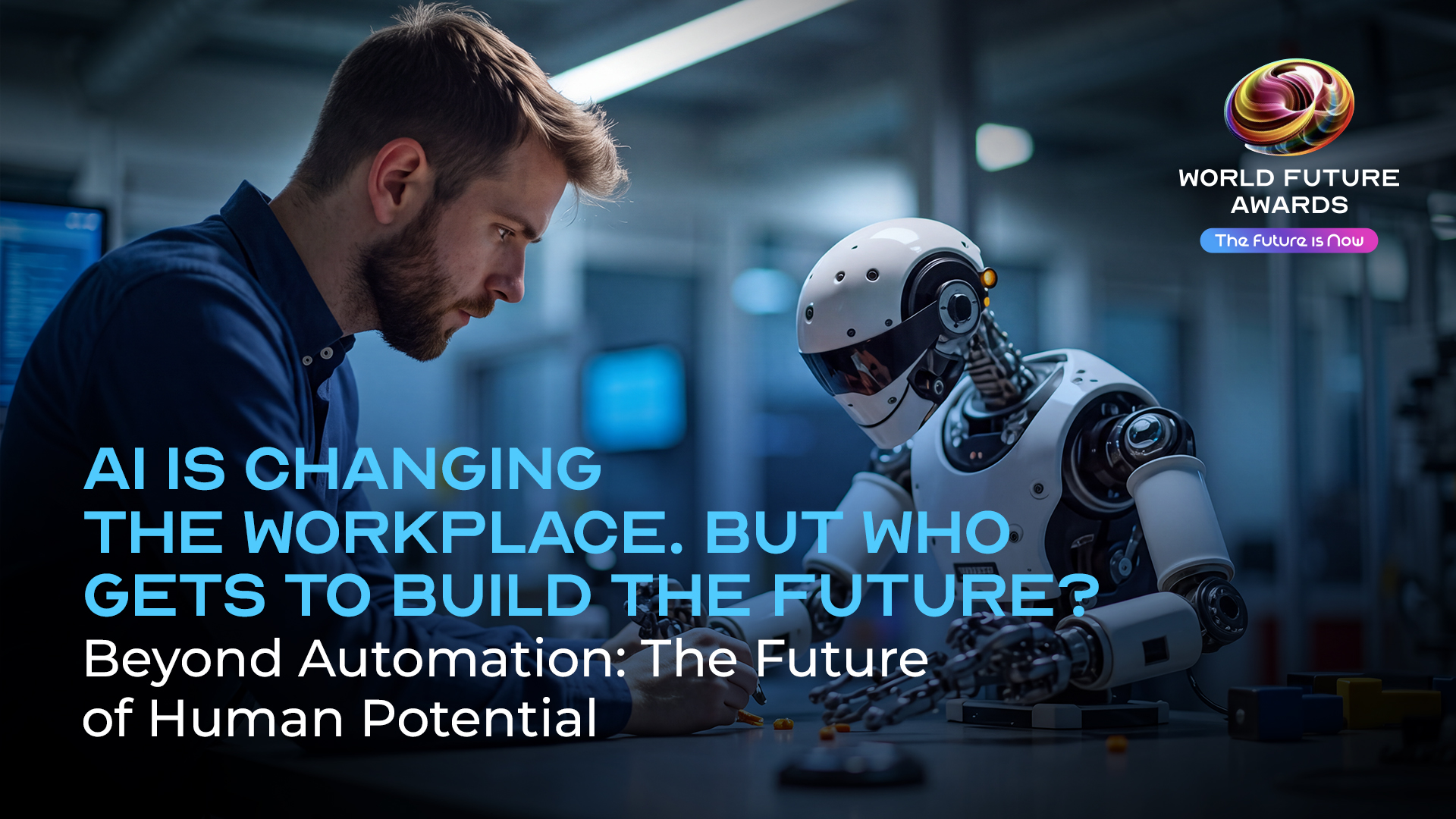
AI Is Changing the Workplace. But Who Gets to Build the Future?
The biggest change in the AI job market may not be mass layoffs. It may be the disappearance of the entry-level opportunities that help people build a career in the first place.
A junior employee starts a first job. They spend the morning researching competitors, drafting a report, checking data and preparing a presentation. None of the tasks is particularly glamorous. Together, they are how someone learns to work: by making mistakes, receiving feedback and gradually taking on more responsibility.
Now imagine a company can automate much of that work.
The immediate calculation looks attractive. A team can produce more with fewer hours spent on routine tasks. But there is a less obvious question behind the productivity gains: if AI takes over the work people once did at the beginning of their careers, where will the next generation gain the experience needed for harder jobs?
This is becoming one of the more consequential questions in the debate over AI and employment. The evidence does not show that AI has already triggered widespread job losses, but recent research suggests the impact on younger workers deserves closer attention.
The warning sign hidden in the employment data
In August 2026, Stanford’s Digital Economy Lab published an updated analysis of payroll data covering millions of US workers through June. Its finding was nuanced: researchers found no evidence of widespread, economy-wide job displacement associated with AI. But they identified a growing gap among younger workers in occupations highly exposed to the technology.
Employment among workers aged 22–25 in those occupations was about 19% below where it would have been if it had kept pace with employment among similarly aged workers in less-exposed occupations. The researchers said the pattern appeared to be driven primarily by reduced hiring, rather than an increase in people losing their jobs.
That distinction matters.
A wave of layoffs is visible. A missing wave of job openings is harder to notice. There may be no dramatic announcement, no office emptied overnight and no single moment when a career path disappears. A company simply decides not to hire as many junior analysts, assistants or entry-level developers because AI can handle more of the work.
The Stanford researchers are careful about what their findings establish. The analysis identifies a pattern; it does not prove that AI alone caused it. Other factors may be contributing, and the data are specific to the US labor market. Still, the widening gap is a reason to examine how employers are changing the way they hire and train people.
The first effects of a technological shift do not always arrive where people expect them.
The entry-level job is more than a job
Routine work has long been part of the bargain at the beginning of a career. It can be repetitive, sometimes tedious and often underpaid. But it also provides a practical education that formal training cannot fully replicate.
A junior researcher learns which sources are credible and which claims need checking. A new designer learns why a technically correct solution may fail a client. An early-career engineer discovers that real systems rarely behave as neatly as examples in a tutorial.
Over time, people build judgment. They learn to recognize exceptions, communicate uncertainty and understand the consequences of their decisions.
AI can help with many of these tasks. It can also help experienced employees work faster. But if organizations remove too many of the tasks through which beginners develop their skills, they risk weakening the pipeline that produces experienced professionals.
Stanford’s analysis found different employment patterns in jobs where AI appears to automate tasks and those where it complements workers. The researchers also highlighted the distinction between codified knowledge—information that can be documented and reproduced—and tacit knowledge developed through practice and experience.
The implication is not that young workers cannot compete with AI. It is that employers may need to rethink how people acquire the skills that make them valuable beyond the tasks AI can perform.
Productivity gains are real. Their distribution is less clear.
There is a strong case for using AI at work. It can help employees process information, generate drafts, explore alternatives and complete certain tasks more quickly. Businesses that use it well may improve output and free people to focus on more complex problems.
But productivity is not the same as shared prosperity.
A June 2026 review by the International Labour Organization examined empirical evidence on generative AI, employment, productivity and work organization. It found that productivity gains are real, but often uneven and not always reflected in higher measured output, earnings or employment. The review also highlighted risks involving inequality, opportunities for younger workers, worker autonomy and job quality.
This is where the conversation needs to move beyond a simple contest between humans and machines.
The important question is not only whether AI can complete a task faster. It is what happens to the time saved, the value created and the opportunities that remain.
Does a company use AI to help employees learn faster and take on more meaningful work? Does it reinvest some of the gains in training? Or does it mainly reduce hiring while expecting the remaining team to deliver more?
Those choices are not dictated by the technology. They are management decisions.
The risk of optimizing for the next quarter
For an individual company, reducing entry-level hiring may make sense in the short term. If a smaller team supported by AI can deliver the same output, the business case can be compelling.
The problem emerges when many employers make similar decisions at once.
Today’s junior employees are tomorrow’s senior specialists, team leaders and founders. If fewer people get the chance to develop practical expertise, organizations may eventually find it harder to recruit the experienced talent they need.
That is a long-term risk, not a settled prediction. The research does not establish that a talent shortage will follow, and the future will depend on how work evolves. New roles may emerge, existing roles may change, and AI may create opportunities that are difficult to anticipate today.
But relying on new jobs to appear is not a workforce strategy. Companies need to consider how people will enter those jobs, learn the craft and progress once they are there.
The transition is particularly important in technology itself. If AI tools become more capable of writing code, analyzing data or producing content, junior professionals may need fewer hours to complete basic tasks. They may also need new ways to learn the reasoning behind the output, rather than simply accepting it.
The challenge is to redesign early-career development—not preserve every old task for its own sake.
What responsible AI adoption should look like
Companies do not need to choose between productivity and people. But they do need to be more deliberate about how they introduce AI into the workplace.
Redesign entry-level roles
If AI takes over repetitive work, employers can give junior staff
structured opportunities to validate outputs, investigate exceptions,
interact with customers and understand the decisions behind the results.
Make learning part of the workflow
Mentorship, feedback and supervised responsibility become more
important when AI can generate a plausible answer before an employee
understands the problem.
Speed should not come at the expense of judgment.
Measure more than efficiency
Time saved and output produced are useful metrics, but so are training
outcomes, employee progression, job quality and the ability of
less-experienced workers to develop expertise.
Be honest about what the evidence says
AI is changing tasks and hiring patterns, but the effects vary across
occupations and remain difficult to isolate. Businesses should not
assume that every role will disappear—or that every worker will
benefit automatically.
These measures will not eliminate disruption. They can, however, help organizations avoid treating the development of future talent as an afterthought.
The future of work starts before the first promotion
The most visible AI stories tend to focus on extraordinary capabilities: models that can reason through complex problems, automate workflows or perform tasks that once required specialized expertise.
Less attention goes to the ordinary moments when people become good at their jobs. The first difficult assignment. The mistake that teaches someone what to check next time. The manager who explains why a polished answer is still the wrong answer.
Those moments rarely appear on a productivity dashboard. Yet they help build the human judgment that organizations will continue to need.
AI may ultimately create more opportunities than it removes. It may also reshape how people enter entire professions. Neither outcome is guaranteed by the technology itself.
What matters now is whether employers build a future in which AI helps people develop their capabilities—or one in which the easiest work disappears before the next generation has a chance to learn from it.
The success of AI at work should not be measured only by what machines can do. It should also be measured by what people are still able to become.