

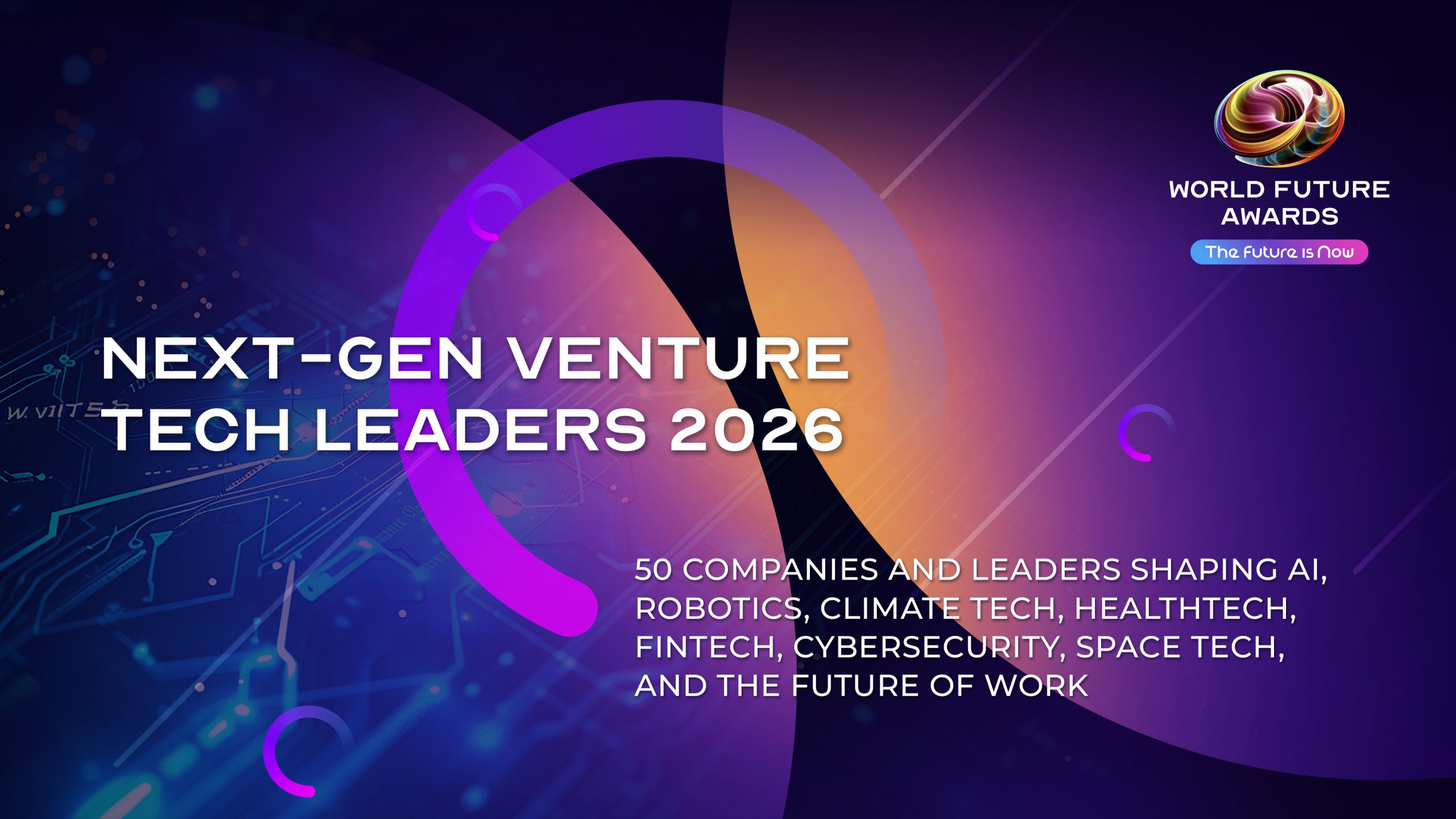
50 Venture Tech Companies and Leaders to Watch in 2026
The builders shaping AI, robotics, climate tech, health, fintech, cybersecurity, space and the future of work.
Which companies are building the next technology era? This World Future Awards watchlist highlights 50 venture tech companies in 2026 and the leaders turning ambitious ideas into practical infrastructure.
The current technology cycle is moving beyond consumer apps and minor software upgrades. Instead, founders are tackling harder problems. They are developing artificial intelligence, robotics, clean energy, healthcare platforms, financial infrastructure, cybersecurity systems and commercial space technologies.
These businesses are difficult to build. Many require advanced research, patient capital, regulatory discipline and real-world deployment. Yet that challenge is precisely why they matter. The strongest venture-backed companies are not simply growing quickly. They are changing how the physical and digital economy works.
For World Future Awards, venture technology offers an early view of the future. It is where scientific ambition meets investment, and where risky ideas become operating companies. Often, these companies introduce important tools before the wider market fully understands their potential.
| At a glance 50 companies across eight future-focused sectors. An editorial watchlist, not a ranking selection based on innovation relevance, market visibility, momentum and WFA fit a strong focus on companies building infrastructure rather than isolated features. |
Why venture tech matters in 2026
The venture market has changed since the low-interest, high-valuation boom. Funding is still available. However, investors are more selective, and capital is increasingly concentrated in companies with clear technical advantages and strong category potential.
Recent venture reports show the scale of that concentration. KPMG’s Venture Pulse Q1 2026 reported $330.9 billion in global venture capital investment across 8,464 deals. AI companies were behind many of the quarter’s largest transactions.
PitchBook-NVCA also described Q1 2026 as an unusually concentrated market. A small number of very large deals had a major effect on the headline totals. In addition, OECD research found that AI firms captured 61% of global venture capital investment in 2025. Generative AI companies alone attracted $35.3 billion.
As a result, capital is not moving evenly across the startup ecosystem. It is clustering around companies that appear foundational. These businesses could become core infrastructure for the next decade.
Three shifts stand out:
- AI concentration: investors continue to support model developers, infrastructure providers and applied AI platforms.
- Deep-tech momentum: robotics, energy, biotech and space companies are attracting attention because technical difficulty can create lasting defensibility.
- Deployment pressure: strong demonstrations are no longer enough. Companies must show reliable products, real customers and a credible path to scale.
What “venture tech” means today
Venture tech once described almost any young technology company backed by venture capital. Today, the category is broader and more consequential. It includes frontier AI laboratories, robotics companies, climate infrastructure startups, AI-first healthcare platforms, biotech businesses, fintech rails, cybersecurity systems, private space companies and adaptive enterprise software.
These businesses do not share one product type. Instead, they share the scale of the problems they are trying to solve. They aim to change how intelligence is accessed, how machines operate, how energy is produced, how medicine is practiced, how money moves and how software is protected.
This feature is not a ranking. It is an editorial watchlist of 50 companies and leaders selected for their innovation relevance, visibility, recent momentum and fit with the World Future Awards focus on future-shaping products, platforms and services.
AI and model infrastructure
AI remains the centre of gravity in venture technology. However, the market has moved beyond chat interfaces. Leading companies are now building models, developer tools and workflow infrastructure for search, legal work, software development, enterprise knowledge, media production and research.
Leaders to watch:
- OpenAI — Sam Altman, CEO
- Anthropic — Dario Amodei, Co-founder & CEO
- Mistral AI — Arthur Mensch, Co-founder & CEO
- Perplexity — Aravind Srinivas, Co-founder & CEO
- Cohere — Aidan Gomez, Co-founder & CEO
- Hugging Face — Clément Delangue, Co-founder & CEO
- Glean — Arvind Jain, Founder & CEO
- Harvey — Winston Weinberg, Co-founder & CEO
- Anysphere — Michael Truell, Co-founder & CEO
- ElevenLabs — Mati Staniszewski, Co-founder & CEO
- Synthesia — Victor Riparbelli, Co-founder & CEO
- Runway — Cristóbal Valenzuela, Co-founder & CEO
- Together AI — Vipul Ved Prakash, Co-founder & CEO
- Sakana AI — David Ha, Co-founder & CEO
The next AI winners will not be judged by model performance alone. Trust, distribution, compute strategy and workflow depth will also matter. Most importantly, successful products must become useful and dependable inside real organisations.
Robotics, physical AI and autonomous systems
After years of software “eating the world,” AI is beginning to move through it. Robotics and autonomous systems bring machine intelligence into warehouses, roads, industrial sites, hospitals, cities and homes.
Leaders to watch:
- Figure AI — Brett Adcock, Founder & CEO
- 1X Technologies — Bernt Øivind Børnich, Founder & CEO
- Agility Robotics — Peggy Johnson, CEO
- Skild AI — Deepak Pathak, Co-founder & CEO
- ANYbotics — Péter Fankhauser, Co-founder & CEO
- Zipline — Keller Rinaudo Cliffton, Co-founder & CEO
- Wayve — Alex Kendall, Co-founder & CEO
The sector is now moving from demonstration to deployment. Therefore, the strongest companies will be those that make robotics reliable, useful and economically practical outside controlled environments.
Climate, energy and industrial transformation
Climate tech has developed from a sustainability narrative into an infrastructure race. Companies in this sector are working on fusion, battery materials, long-duration storage, carbon removal, carbon transformation and green hydrogen.
Leaders to watch:
- Commonwealth Fusion Systems — Bob Mumgaard, CEO
- Helion Energy — David Kirtley, Founder & CEO
- Form Energy — Mateo Jaramillo, Co-founder & CEO
- Redwood Materials — JB Straubel, Founder & CEO
- Climeworks — Christoph Gebald, Co-founder & Co-CEO
- Twelve — Nicholas Flanders, Co-founder & CEO
- Electric Hydrogen — Raffi Garabedian, Co-founder & CEO
These are capital-intensive fields. Nevertheless, they can reshape the physical economy. The leading companies are not selling climate optimism; they are building systems that could make industrial decarbonisation technically and economically possible.
Healthtech, biotech and AI for science
Healthcare is one of the most demanding markets for innovation because the stakes are human. At the same time, the opportunity is enormous. AI can reduce administrative work, support clinicians, improve preventive care and accelerate drug discovery.
Leaders to watch:
- Abridge — Shivdev Rao, Founder & CEO
- Hippocratic AI — Munjal Shah, Co-founder & CEO
- Neko Health — Hjalmar Nilsonne, Co-founder & CEO
- Insilico Medicine — Alex Zhavoronkov, Founder & CEO
- Generate:Biomedicines — Mike Nally, CEO
- Cradle — Stef van Grieken, Co-founder & CEO
Speed alone will not determine success. Healthtech and biotech companies also need clinical evidence, regulatory discipline and trust from doctors, patients and research institutions.
Fintech and global financial infrastructure
The strongest fintech companies are no longer focused only on making payments easier. Increasingly, they act as operating systems for global business. Their platforms combine payments, banking, spend management, cross-border transactions and financial automation.
Leaders to watch:
- Stripe — Patrick Collison, Co-founder & CEO
- Revolut — Nik Storonsky, Co-founder & CEO
- Ramp — Eric Glyman, Co-founder & CEO
- Brex — Henrique Dubugras, Co-founder & Co-CEO
- Airwallex — Jack Zhang, Co-founder & CEO
As companies become more international, financial infrastructure must become faster, more flexible and easier to integrate.
Cybersecurity and trust infrastructure
Security is becoming a critical layer of the AI economy. Software is produced faster, systems are more automated and sensitive data moves across more tools. Consequently, trust, governance and secure infrastructure are strategic advantages.
Leaders to watch:
- Wiz — Assaf Rappaport, Co-founder & CEO
- Chainguard — Dan Lorenc, Co-founder & CEO
- Semgrep — Isaac Evans, Founder & CEO
- Island — Mike Fey, Co-founder & CEO
AI can help defenders, but it can also strengthen attackers. For that reason, cybersecurity businesses may become some of the most important infrastructure companies of the decade.
Space technology and frontier infrastructure
Space is moving from a government-dominated frontier toward a commercial infrastructure market. Satellite connectivity, advanced manufacturing, orbital logistics, research platforms and private space stations are becoming serious venture categories.
Leaders to watch:
- Astranis — John Gedmark, Co-founder & CEO
- Relativity Space — Tim Ellis, Co-founder & CEO
- Varda Space Industries — Will Bruey, Co-founder & CEO
- Impulse Space — Tom Mueller, Founder & CEO
- Axiom Space — Tejpaul Bhatia, CEO
The opportunity extends beyond launch services. Companies are building the systems required for a broader, more reliable commercial space economy.
Enterprise software and the future of work
AI, global hiring and flexible collaboration are reshaping the workplace. As a result, the next generation of enterprise software is becoming less rigid and more adaptive.
Leaders to watch:
- Notion — Ivan Zhao, Co-founder & CEO
- Deel — Alex Bouaziz, Co-founder & CEO
The strongest platforms help distributed teams organise knowledge, make faster decisions and manage international operations.
What the 50 venture tech companies have in common
The companies on this watchlist operate in very different markets. Even so, the strongest businesses share several characteristics:
- They build infrastructure, not just individual features.
- They operate in markets where technical difficulty can create defensibility.
- They combine ambitious research with practical deployment.
- They treat trust, security and reliability as product requirements.
- They solve problems that matter to large industries or global systems.
Another pattern is clear: AI is no longer a single vertical. It is becoming an operating layer across legal work, healthcare, coding, robotics, cybersecurity, drug discovery, knowledge management and creative production.
Therefore, the central question is no longer whether AI will influence venture tech. The question is which companies will use it to create products that work in complex, regulated and physical environments.
What comes next for venture technology
The next phase will be defined by execution. AI companies must convert attention into durable products and revenue. Robotics companies must prove that intelligent machines can operate safely and consistently. Climate companies must move from pilot projects to industrial scale.
Meanwhile, healthtech and biotech companies must balance speed with evidence. Cybersecurity providers must protect systems that are changing faster than many organisations can govern them.
The venture market is also likely to remain top-heavy. Investors will continue to fund companies they believe can define a category. Everyone else will need to prove more with less. Although that pressure is difficult, it may reward businesses with real technology, serious teams and a clear reason to exist.
Venture tech belongs in the World Future Awards conversation
World Future Awards recognises innovation that can shape society, improve industries and create better ways of living and working. Venture tech belongs in that conversation because it is often where the future becomes visible first.
The leaders featured in this research are not only building companies. They are testing new assumptions: intelligence can become more accessible, machines can become more useful, energy can become cleaner, healthcare can become more proactive, finance can become more global, software can become more secure and space can become part of the commercial economy.
That is the real story behind the venture tech companies of 2026. It is not only about funding rounds or valuations. It is about turning difficult technology into infrastructure that people and organisations can use.
| Rank | Company | Category | Region | Short bio / profile angle | Recent achievement |
|---|---|---|---|---|---|
| 1 | OpenAI | AI & Model Infrastructure | United States | Frontier AI lab building models, developer tools, and enterprise AI products. Altman remains one of the most visible leaders in the global AI wave. | AI mega-round and product ecosystem leader; included as a core benchmark for venture-backed AI scale-ups. |
| 2 | Anthropic | AI & Model Infrastructure | United States | Anthropic develops Claude and focuses on AI safety, enterprise adoption, and frontier model research. Amodei is a key voice in responsible AI and model capability debates. | One of the central companies in the 2025-2026 AI investment cycle. |
| 3 | Mistral AI | AI & Model Infrastructure | France | Mistral AI is a European frontier AI company known for open and commercial model releases. Mensch represents Europe’s push to build globally competitive AI infrastructure. | Recognized on AI startup/watch lists and in European deep tech coverage. |
| 4 | Perplexity | AI & Model Infrastructure | United States | Perplexity is building AI-native search and answer technology for consumers and knowledge workers. Srinivas has become a recognizable founder in the new search and agentic information layer. | Major AI search scale-up frequently cited in AI startup coverage. |
| 5 | Cohere | AI & Model Infrastructure | Canada | Cohere builds enterprise-focused large language models and retrieval systems. Gomez is known as one of the authors of the Transformer paper and a founder focused on secure enterprise AI. | Recognized in AI market reports and enterprise AI analysis. |
| 6 | Hugging Face | AI & Model Infrastructure | United States / France | Hugging Face has become a core platform for open-source AI models, datasets, and collaboration. Delangue leads one of the most developer-loved companies in the AI ecosystem. | Widely cited in AI ecosystem reports and open-source AI discussions. |
| 7 | Glean | AI & Enterprise Productivity | United States | Glean builds enterprise search and AI assistants that connect workplace knowledge. Jain brings strong product and infrastructure experience to the enterprise AI category. | Prominent enterprise AI company in 2025-2026 funding and adoption discussions. |
| 8 | Harvey | AI & Legal Tech | United States | Harvey applies generative AI to legal workflows, professional services, and enterprise knowledge work. Weinberg represents a new wave of vertical AI founders. | Frequently covered as a leading vertical AI company for law firms and enterprises. |
| 9 | Anysphere | AI & Developer Tools | United States | Anysphere is the company behind Cursor, an AI-powered code editor. Truell represents the developer tools segment where AI is quickly changing software creation. | Cursor became one of the most discussed AI developer products of 2025. |
| 10 | ElevenLabs | AI & Voice | United Kingdom / United States | ElevenLabs builds AI voice, audio generation, dubbing, and creative speech tools. Staniszewski leads one of the most visible companies in synthetic media. | Recognized in AI startup and European deep tech reports. |
| 11 | Synthesia | AI & Video | United Kingdom | Synthesia creates AI video generation tools for enterprise communication and training. Riparbelli is a leading founder in synthetic video and business communication. | Included in AI and European deep tech coverage. |
| 12 | Runway | AI & Creative Tools | United States | Runway builds generative AI tools for video, design, and creative production. Valenzuela has helped make AI creation more accessible to artists, studios, and brands. | Recognized in AI 50-style coverage and generative media reports. |
| 13 | Together AI | AI & Infrastructure | United States | Together AI provides infrastructure for training, fine-tuning, and running open models. Prakash is building in the critical compute and model deployment layer. | Part of the fast-growing AI infrastructure category in 2025-2026. |
| 14 | Sakana AI | AI & Research Labs | Japan | Sakana AI is a Tokyo-based AI research lab exploring nature-inspired AI and new model-development approaches. Ha is known for research leadership and creative machine learning work. | Recognized in global AI startup coverage and funding discussions. |
| 15 | Figure AI | Robotics & Physical AI | United States | Figure AI develops humanoid robots for labor, logistics, and industrial environments. Adcock is one of the most visible founders in the humanoid robotics boom. | Humanoid robotics attracted strong funding and media attention in 2025-2026. |
| 16 | 1X Technologies | Robotics & Physical AI | Norway / United States | 1X develops humanoid robots designed for home and workplace environments. Børnich represents Europe’s role in the global physical AI race. | Regularly included in humanoid robotics and physical AI discussions. |
| 17 | Agility Robotics | Robotics & Physical AI | United States | Agility Robotics builds Digit, a humanoid robot for logistics and warehouse use cases. Johnson leads commercialization efforts in practical industrial robotics. | Agility is cited in major robotics interviews and AI influence coverage. |
| 18 | Skild AI | Robotics & Physical AI | United States | Skild AI builds foundation models for robotics and embodied intelligence. Pathak’s academic and startup work sits at the intersection of reinforcement learning and real-world robots. | Physical AI and robotics foundation models are key 2025-2026 venture themes. |
| 19 | ANYbotics | Robotics & Autonomous Systems | Switzerland | ANYbotics develops autonomous inspection robots for industrial sites. Fankhauser leads a Swiss robotics company focused on safety, inspection, and operational efficiency. | Recognized as a strong European robotics scale-up. |
| 20 | Zipline | Robotics & Drone Logistics | United States / Global | Zipline uses autonomous aircraft for instant logistics and medical delivery. Rinaudo Cliffton has helped build one of the world’s most visible drone delivery networks. | Well-known venture-backed robotics/logistics company with broad deployment footprint. |
| 21 | Wayve | Autonomous Mobility | United Kingdom | Wayve builds embodied AI for autonomous driving using end-to-end learning. Kendall is a major figure in AI-first autonomous mobility. | UK AI/autonomous driving funding and global expansion signal. |
| 22 | Commonwealth Fusion Systems | Climate & Energy Tech | United States | Commonwealth Fusion Systems is pursuing commercial fusion energy. Mumgaard leads one of the most advanced private fusion efforts with a strong scientific and venture backing story. | Fusion remains one of the highest-impact climate and energy bets in venture-backed deep tech. |
| 23 | Helion Energy | Climate & Energy Tech | United States | Helion Energy is building fusion power technology with a direct electricity generation approach. Kirtley represents the founder-led push toward commercially viable fusion. | Fusion energy continues to attract attention in climate tech and frontier hard tech. |
| 24 | Form Energy | Climate & Energy Tech | United States | Form Energy develops long-duration iron-air battery systems for the electric grid. Jaramillo leads a company addressing renewable energy storage at utility scale. | Long-duration storage is a key category in climate tech investment. |
| 25 | Redwood Materials | Climate & Circular Economy | United States | Redwood Materials focuses on battery recycling, materials recovery, and circular supply chains. Straubel brings Tesla and battery expertise to a critical climate infrastructure problem. | Battery recycling and critical minerals remain important climate tech themes. |
| 26 | Climeworks | Climate & Carbon Removal | Switzerland | Climeworks builds direct air capture technology for carbon removal. Gebald is a notable European climate tech founder in one of the most visible carbon removal companies. | Direct air capture remains a prominent climate tech and net-zero category. |
| 27 | Twelve | Climate & Carbon Transformation | United States | Twelve converts CO2 into chemicals, fuels, and materials using electrochemistry. Flanders leads a company turning carbon into a feedstock for industrial transformation. | Carbon transformation remains an important frontier in climate tech. |
| 28 | Electric Hydrogen | Climate & Green Hydrogen | United States | Electric Hydrogen develops high-power electrolyzers for low-cost green hydrogen production. Garabedian leads a climate company targeting heavy industry decarbonization. | Green hydrogen is a key climate infrastructure category despite market selectivity. |
| 29 | Abridge | Healthtech & AI | United States | Abridge uses AI to generate clinical documentation and reduce administrative load for clinicians. Rao combines medical practice with health technology entrepreneurship. | One of the most visible healthcare AI scale-ups in recent funding and adoption coverage. |
| 30 | Hippocratic AI | Healthtech & AI | United States | Hippocratic AI develops safety-focused healthcare agents for non-diagnostic patient-facing tasks. Shah is a serial founder working at the intersection of AI and healthcare access. | Healthcare agents are part of the broader shift toward vertical AI. |
| 31 | Neko Health | Healthtech & Preventive Care | Sweden | Neko Health builds preventive health scanning and diagnostics experiences. Nilsonne leads a European healthtech company focused on early detection and consumer-friendly care. | European healthtech scale-up attracting global attention. |
| 32 | Insilico Medicine | Biotech & AI Drug Discovery | Hong Kong / United States | Insilico Medicine applies AI to drug discovery and aging research. Zhavoronkov is a long-running voice in AI-driven biotech and longevity science. | AI drug discovery remains a key area in venture and scientific innovation. |
| 33 | Generate: Biomedicines | Biotech & Protein Design | United States | Generate:Biomedicines uses machine learning to design novel proteins and therapeutics. Nally leads a company positioned at the intersection of biology, computation, and drug development. | Generative biology is a frontier category in biotech venture investing. |
| 34 | Cradle | Biotech & AI Design | Netherlands / Switzerland | Cradle builds AI tools for protein engineering and biotech R&D teams. Van Grieken represents the new generation of European bio-AI founders. | Recognized in European deep tech and AI-bio discussions. |
| 35 | Stripe | Fintech & Payments | United States / Ireland | Stripe builds financial infrastructure for internet businesses. Collison remains one of the most influential founders in global fintech and developer-first payments. | Late-stage private fintech leader with global infrastructure relevance. |
| 36 | Revolut | Fintech & Digital Banking | United Kingdom | Revolut is a global financial super-app spanning banking, payments, trading, and business accounts. Storonsky leads one of Europe’s most valuable private fintech companies. | European fintech leader often referenced in venture ecosystem reports. |
| 37 | Ramp | Fintech & Spend Management | United States | Ramp builds finance automation, corporate cards, and spend management tools for businesses. Glyman leads a fast-growing fintech focused on efficiency and cost control. | Strong recent fintech growth and funding visibility. |
| 38 | Brex | Fintech & Business Banking | United States | Brex provides corporate cards, expense management, and financial services for startups and enterprises. Dubugras is a prominent fintech founder from Brazil operating globally. | Well-known venture-backed fintech scale-up. |
| 39 | Airwallex | Fintech & Global Payments | Australia / Singapore | Airwallex builds global payments and financial infrastructure for businesses. Zhang leads a major Asia-Pacific fintech scale-up with global expansion momentum. | Asia-Pacific fintech leader with international growth profile. |
| 40 | Wiz | Cybersecurity & Cloud Security | Israel / United States | Wiz provides cloud security and risk management for enterprises. Rappaport built one of the fastest-growing cybersecurity companies of the decade. | Major cybersecurity scale-up and acquisition/IPO-watch company. |
| 41 | Chainguard | Cybersecurity & Software Supply Chain | United States | Chainguard builds secure software supply chain infrastructure and hardened open-source components. Lorenc is an important founder in securing how modern software is built. | Software supply chain security remains a priority area for enterprises and investors. |
| 42 | Semgrep | Cybersecurity & Developer Security | United States | Semgrep builds developer-first code security tools. Evans leads a company focused on making secure coding easier and faster for engineering teams. | Developer security is a growing cybersecurity category. |
| 43 | Island | Cybersecurity & Enterprise Browser | United States / Israel | Island created an enterprise browser designed for security, productivity, and manageability. Fey brings deep cybersecurity leadership experience to a new enterprise software category. | Raised major funding and reached a multi-billion valuation in 2025 coverage. |
| 44 | Astranis | Space Tech | United States | Astranis builds small geostationary satellites to expand broadband connectivity. Gedmark leads a space startup targeting lower-cost connectivity infrastructure. | Private space infrastructure remains a strong frontier tech category. |
| 45 | Relativity Space | Space Tech | United States | Relativity Space develops reusable rockets and advanced manufacturing approaches for launch. Ellis is one of the most prominent founders in private aerospace. | Space and launch infrastructure continue to attract strategic venture attention. |
| 46 | Varda Space Industries | Space Tech | United States | Varda Space Industries develops in-space manufacturing and reentry capsules. Bruey leads a company exploring how microgravity can enable new industrial processes. | Space manufacturing is one of the more futuristic venture-backed categories. |
| 47 | Impulse Space | Space Tech | United States | Impulse Space builds in-space transportation and orbital maneuvering vehicles. Mueller brings rocket engineering credibility from SpaceX to next-generation space logistics. | Space logistics is an emerging layer in commercial space infrastructure. |
| 48 | Axiom Space | Space Tech | United States | Axiom Space is developing a commercial space station and private astronaut missions. Bhatia leads the company’s commercial transformation of low-Earth orbit. | Axiom appointed Bhatia CEO in 2025 and continues commercial space station work. |
| 49 | Notion | Enterprise Software & Productivity | United States | Notion is a workspace and productivity platform increasingly integrating AI into collaboration. Zhao has built a design-led company with a passionate global user community. | Notion remains a major private productivity platform and AI workspace contender. |
| 50 | Deel | Enterprise Software & Future of Work | United States / Global | Deel builds global HR, payroll, compliance, and workforce management infrastructure. Bouaziz leads a company that reflects how work has become more distributed and international. | Major venture-backed software scale-up with global enterprise relevance. |
| Is your company building a breakthrough? World Future Awards welcomes innovations in AI, robotics, climate tech, healthtech, biotech, fintech, cybersecurity, space technology and the future of work. Apply for World Future Awards |
MORE NEWS
The New Space Race Is Becoming a Technology Race

Top 25 Biotech Breakthroughs Shaping 2026
The Rise of the Physical AI Economy

The New Game Masters: World Leaders Shaping the Future of Gaming

EMCD: Building the Future of Integrated Digital Assets

EMCD Wins World Future Awards 2026 for Best Integrated Digital Asset Ecosystem

Speexx Launches Online Language Training for Railway Staff to Support Safer, Multilingual Rail Operations
NEWSLETTER
Sign up to learn more about our project and to stay up to date.