
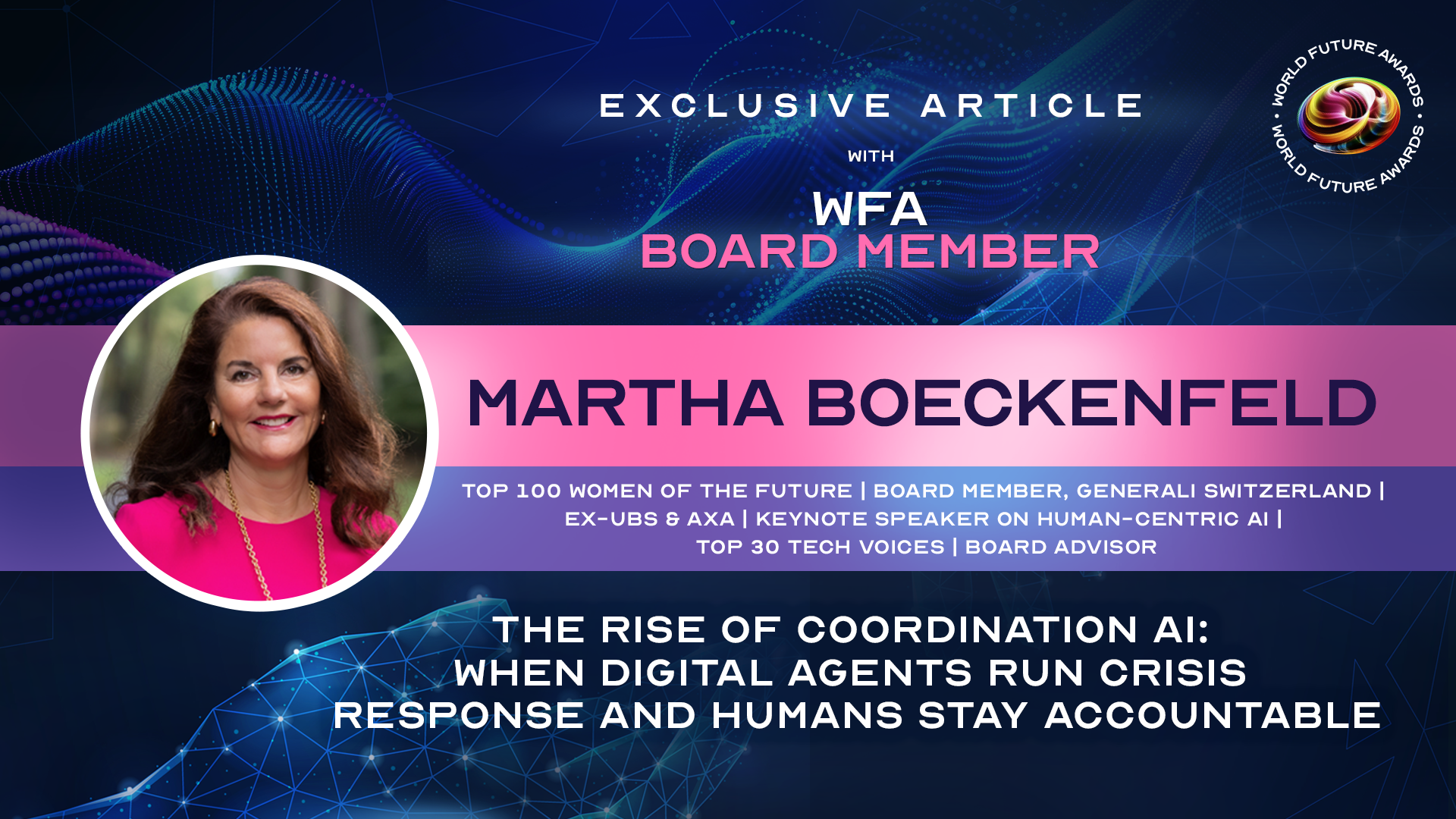
The Rise of Coordination AI: When Digital Agents Run Crisis Response — and Humans Stay Accountable
By Martha Boeckenfeld, Top 100 Women of the Future | Board Member, Generali Switzerland | Former UBS & AXA Executive | Keynote Speaker on Human-Centric AI
When Seconds Decide
When a wildfire tears through a city at 3 a.m., the difference between survival and catastrophe is no longer defined only by training or equipment. It is increasingly defined by decision speed.
Emergency coordinators must simultaneously deploy dispatch teams, track infrastructure failures, redirect evacuations, and manage a flood of incoming 911 calls. Research shows that in multi-agency scenarios, the lag between an incident occurring and a coordinated response being confirmed can average between 8 and 14 minutes. In the case of a structural collapse or a fast-moving fire, that delay can cost lives.
Agentic AI — systems that do not simply answer questions, but take autonomous, sequential actions — is beginning to change that equation. And it is doing so not only in research environments, but in operational settings today.
From Assistant to Orchestrator
Traditional AI in emergency management has largely played an advisory role: surfacing data, flagging patterns, and suggesting options. A human still had to interpret the output, make a decision, and relay instructions across multiple teams.
Agentic and multi-agent AI works differently. It acts.
Multiple specialized agents can run simultaneously: one monitors citywide camera feeds, another transcribes 911 calls in real time, a third cross-references logistics and resource availability, while a coordinating agent synthesizes all of this into a recommended response plan that is updated second by second.
Leidos and NVIDIA are already building in this direction. Their C2AI system deploys a network of task-specific agents inside emergency operations centers. When a building partially collapses, a visual alerts agent analyzes camera footage and reports: “A building collapse is happening, with debris scattered around. No visible signs of fire or individuals in distress.” Seconds later, when embers appear in another feed, the EMS planning agent updates its recommendation and presents the incident commander with a revised dispatch plan, asking: “Affirm plan or provide input for revision.”
That single line captures the governance model at the heart of coordination AI: machines move at machine speed, but humans remain responsible for judgment and authorization.
The Scale of What Is Possible
A FEMA-backed simulation found that AI-assisted coordination reduced critical response lag by as much as 40% in complex, multi-agency scenarios. For context, if a major incident currently takes 12 minutes to coordinate, agentic AI could reduce that timeline to closer to 7. Across thousands of incidents each year, the cumulative effect on outcomes — including injuries, fatalities, and infrastructure damage — could be substantial.
The case extends well beyond fires and floods.
A 2026 study published in npj Digital Medicine examined how hospitals struggled during the 2021 Canadian heatwave. Temperatures approached 50°C, roads buckled, ICUs were overwhelmed, and patients died in care facilities. The authors argue that static emergency protocols, designed around historical worst-case assumptions, are no longer sufficient for climate events that now regularly exceed those assumptions. Their conclusion is clear: for hospitals preparing for what is actually coming, agentic AI is no longer a future-facing option, but an emerging operational necessity.
The Problem We Cannot Automate Away
Despite its promise, coordination AI introduces a risk that no algorithm can solve on its own: the erosion of accountability. The faster AI orchestrates, the easier it becomes to assume that the system itself is responsible for the outcome. It is not.
In December 2025, the European Commission’s Science Advice Mechanism reviewed AI in emergency management and found that while the technology’s potential is significant, real-world adoption remains limited. The central unresolved challenge is trust between human responders and AI systems. Responders hesitate to rely on outputs they cannot interpret. Commanders are understandably wary of acting on recommendations they may later be unable to explain.
These are not purely technical issues. They are governance issues. They are leadership issues. And they are cultural issues.
There is also the question of what happens when the agents are wrong. An AI system operating at speed, with broad systems access and persistent memory, can propagate a flawed assumption across an entire response plan before a human notices. Decision trails — auditable logs showing what an agent did, when it did it, and why — are not a bureaucratic formality. They are the mechanism that keeps a human decision-maker genuinely accountable for what occurred.
The Real Breakthrough
The most important breakthrough in coordination AI will not be the agent that runs the fastest or integrates the greatest number of data sources.
It will be the governance frameworks, accountability architectures, and leadership cultures that ensure a human being remains answerable for the outcome.
Technology alone will not save us. We will.
And that means we must be far more deliberate about where machine judgment ends and human judgment begins — before the next crisis arrives, not in the middle of it.
References
- FEMA / Leidos operational research on multi-agency response coordination, 2024
- Leidos, Agentic AI Aims to Cut Down Emergency Response Time When Disasters Strike, October 2025
- FEMA-backed multi-agency simulation data on AI-assisted coordination lag reduction, 2024
- Gish & Rapaport, Agentic AI Can Help Hospitals Prepare for Unprecedented Weather, npj Digital Medicine, January 2026
- European Commission Science Advice Mechanism, AI in Emergency and Crisis Management, December 2025
MORE NEWS
The New Space Race Is Becoming a Technology Race
Top 25 Biotech Breakthroughs Shaping 2026
The Rise of the Physical AI Economy
50 Venture Tech Companies and Leaders to Watch in 2026
The New Game Masters: World Leaders Shaping the Future of Gaming

EMCD: Building the Future of Integrated Digital Assets

EMCD Wins World Future Awards 2026 for Best Integrated Digital Asset Ecosystem
NEWSLETTER
Sign up to learn more about our project and to stay up to date.