

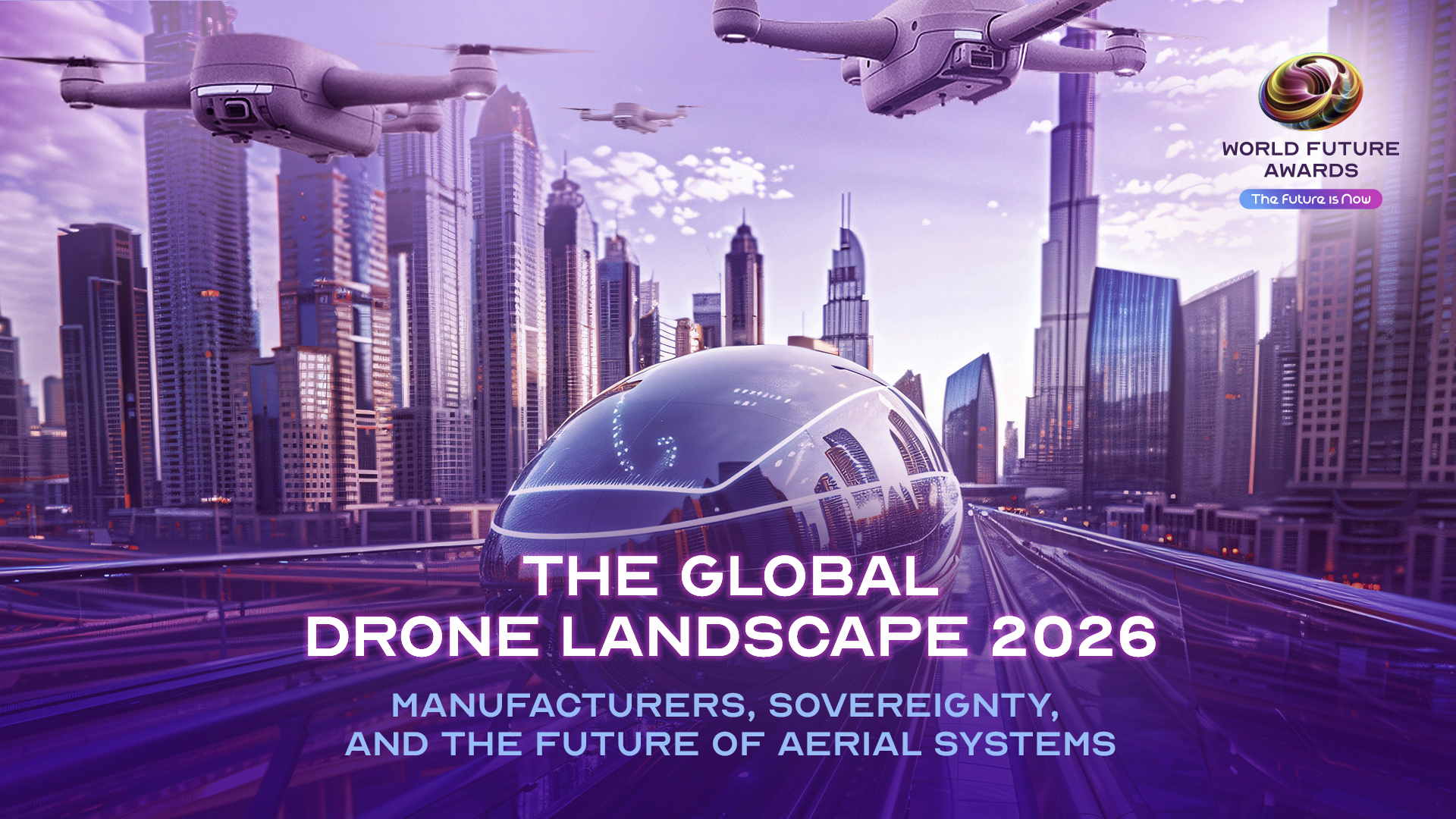
The Global Drone Landscape 2026
Manufacturers, Sovereignty, and the Future of Aerial Systems
Drones have moved far beyond their early identity as niche flying devices. In 2026, they are becoming part of the operating fabric of modern society — used in public safety, inspection, surveying, agriculture, emergency response, industrial monitoring, logistics, and, increasingly, national resilience. What once felt like an emerging product category now looks much more like strategic infrastructure.
A Category Becoming Core Infrastructure
That shift is visible not only in market demand, but in the way governments and institutions now treat the sector. In the United States, the FAA reported more than 966,000 commercial small drones at the end of 2024 and projected that number would rise to about 1.089 million in 2026. The agency also reported 405,682 remote pilot certifications as of December 2024. In Europe, EASA continues to structure civil drone operations through its “open,” “specific,” and “certified” categories — a sign that drones are no longer operating on the margins of aviation, but within an increasingly formal and regulated system.
As adoption deepens, regulation is tightening as well. In February 2026, the FAA said unsafe or unauthorized drone operators could face penalties of up to $75,000 per violation. That is more than a legal detail; it is a marker of how seriously airspace integrity, public safety, and operational trust are now being treated. Drones are no longer seen simply as tools of innovation. They are increasingly understood as systems that must earn confidence from regulators, institutions, and the public.
Beyond Hardware: The New Competitive Layer
What makes the global drone story especially important today is that the market is no longer being defined by hardware alone. Performance still matters, of course, but the next era of leadership will be shaped just as much by autonomy, software, cybersecurity, trusted architectures, and sovereign manufacturing. In other words, the real competitive question is no longer only who can build a drone, but who can build a drone ecosystem that others are willing to depend on.
This is why the current global manufacturer landscape deserves close attention. DJI (China) remains the most structurally important commercial drone company in the world because of its scale, reach, and product breadth across agriculture, energy, mapping, inspection, and public safety. Yet even DJI’s positioning shows where the market is heading: trust has become central. Privacy controls, security assurances, and data-handling practices are no longer side notes in enterprise communications. They are now part of the value proposition itself.
In the Western ecosystem,Skydio (United States) stands out as one of the clearest autonomy-first companies. Its strength lies not only in aircraft design, but in the software layer around real operational use cases, including Drone as First Responder programs, automated inspection, remote operations, and public-safety workflows. Its 2025 selection under a NATO Support and Procurement Agency framework also strengthened its profile beyond domestic enterprise deployment, reinforcing the idea that autonomy-led drone companies are increasingly strategic actors, not just product vendors.
Parrot (France) is another company to watch closely, especially within the growing narrative of trusted European and allied drone capability. Its positioning around ANAFI USA and ANAFI UKR speaks directly to a market that is beginning to separate into different trust tiers as much as different product segments. This is one of the clearest signs of where the industry is heading: buyers are not only comparing flight performance or payload capacity, but also evaluating supply-chain confidence, compliance posture, and geopolitical comfort.
Strategic Systems and the Sovereignty Question
The defense and strategic systems side of the sector is moving just as quickly. AeroVironment, General Atomics, Shield AI, and Baykar each represent a different dimension of this shift: battlefield-scale deployment, long-endurance unmanned aviation, operations in contested environments, and export-driven strategic reach. What matters here is not simply that these companies build advanced systems. It is that they are helping redefine how drones fit into modern security architectures — as persistent, intelligent, and operationally integrated capabilities rather than isolated platforms.
Shield AI’s positioning is especially instructive because it reflects the industry’s move toward resilience under pressure. Platforms designed for GNSS-denied or communications-contested environments are not just military products; they are signals of where technological expectations are going. Reliability in imperfect, hostile, or degraded conditions is becoming a defining standard for high-value drone systems.
At the same time, the rise of sovereign drone manufacturing is becoming a truly global story. India’s efforts to reduce dependence on imported components, Türkiye’s export momentum through Baykar, and the broader emphasis on domestic capability across multiple regions all point in the same direction. Sovereign manufacturing is no longer a narrow political concept. It is becoming an industrial priority tied to resilience, procurement confidence, and long-term strategic autonomy.
Why Ukraine Matters
For World Future Awards, however, one of the most important chapters in this story is Ukraine. Ukraine should not be treated as a side note in the international drone market. It should be recognized as one of the most dynamic and fast-evolving drone ecosystems in the world. The scale of domestic procurement, the speed of battlefield innovation, and the growing role of local manufacturers all suggest that Ukraine is no longer only responding to necessity — it is actively shaping the future direction of drone development.
That is what makes the Ukrainian ecosystem so strategically significant. Reuters reported in March 2025 that Ukraine planned to procure around 4.5 million FPV drones in 2025 after buying more than 1.5 million in 2024, with 96% sourced from Ukrainian manufacturers and suppliers. At the same time, Brave1 has emerged as an important national defense-tech platform connecting innovators, government, investors, and international partners. Together, these developments point to an ecosystem that is rapidly converting urgency into industrial capability.
What is even more important now is that Ukraine’s drone sector is beginning to attract broader international industrial attention. Reuters reported on March 30, 2026, that Ukrainian companies such as UForce, Wild Hornets, and SkyFall were drawing outside interest as the country explored drone export opportunities. On April 1, 2026, Reuters also reported that Romania and Ukraine were advancing talks on EU-backed joint drone production, with 15 Ukrainian companies involved in the discussions and €200 million in Romanian SAFE-related funding earmarked for joint manufacturing. This is a meaningful signal that Ukraine is increasingly being viewed not only as a wartime innovator, but as a future manufacturing and partnership ecosystem with wider regional relevance.
The Next Decade Will Be Built on Trust
The strategic conclusion is becoming difficult to ignore. The drone sector is entering a new era in which manufacturers will be judged not only by flight performance, but by autonomy, resilience, compliance, software integration, trusted supply chains, and ecosystem relevance. The companies that define the next decade will not simply build drones. They will build aerial systems, operating environments, and industrial capabilities that governments, enterprises, and societies increasingly rely on.
From the WFA perspective, this is exactly why drones deserve much closer attention as a defining technology field of the future. They sit at the intersection of autonomy, real-world utility, resilience, advanced manufacturing, and trusted innovation. As this landscape continues to evolve, World Future Awards will be watching the manufacturers, ecosystems, and breakthrough companies helping shape the future of aerial systems worldwide.
| WFA Perspective At World Future Awards, we do not see drones as a narrow hardware category. We see them as a convergence point for autonomy, real-world utility, resilience, advanced manufacturing, and trusted innovation — a space that will define major industrial and societal capabilities in the years ahead. |
MORE NEWS

TOP 20 FUTURE TECH UNIVERSITIES 2026
VVater Wins WFA 2026 for Next-Generation Sustainable Water Treatment Technology

VVater: Electrifying the Future of Sustainable Water Treatment
The New Space Race Is Becoming a Technology Race

Top 25 Biotech Breakthroughs Shaping 2026

The Rise of the Physical AI Economy
50 Venture Tech Companies and Leaders to Watch in 2026
NEWSLETTER
Sign up to learn more about our project and to stay up to date.