

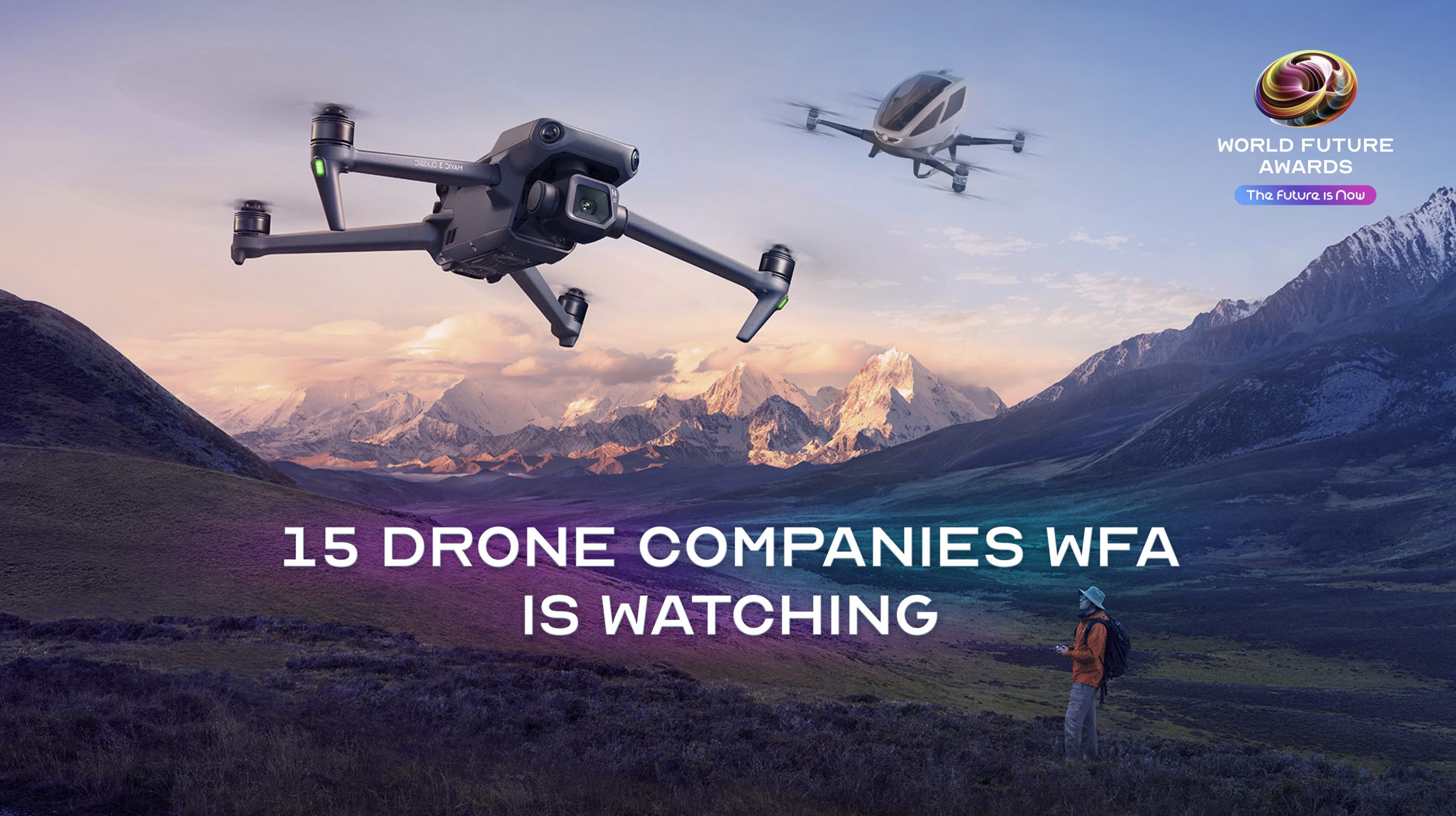
15 Drone Companies WFA Is Watching
The global drone industry is no longer defined by hardware alone. Today, the sector represents a convergence of autonomy, software, secure communications, infrastructure intelligence, public safety, emergency response, and sovereign manufacturing. Drones are rapidly evolving into essential tools for governments, enterprises, and critical industries worldwide.
In the United States alone, the FAA projects the commercial drone fleet to exceed one million aircraft in 2025, while remote-pilot certifications continue to expand. This growth reflects how drone technology is moving deeper into regulated, professional, and institutional use cases across infrastructure, logistics, energy, agriculture, mapping, and security operations.
At the same time, the drone market is entering a new era in which trust, compliance, resilience, and supply-chain confidence matter as much as flight performance itself. The Special Competitive Studies Project reported that DJI products still account for approximately 70% to 90% of drones used across U.S. applications, while Reuters noted in January 2026 that Washington withdrew one proposed restriction plan on Chinese-made drones even as separate FCC restrictions on new foreign-made models remained in place.
This dynamic highlights one of the most important strategic questions shaping the future of autonomous systems today: who will define the next generation of trusted aerial systems?
This WFA watchlist is not a ranking. It is a research-led selection of drone companies shaping the future of commercial drones, autonomous systems, public safety, infrastructure intelligence, resilient deployment models, and sovereign technological capability.
1. Skydio 🇺🇸
Skydio stands out as one of the strongest autonomy-first players in the Western market. Its positioning across public safety, inspection, and remote operations — combined with its selection under a NATO procurement framework in 2025 — makes it a key company to watch in the rise of trusted autonomous systems.
2. Parrot 🇫🇷
Parrot is highly relevant to the European trusted-drone conversation. Its ANAFI USA line is positioned as Blue sUAS-approved and NDAA/TAA-compliant, while the broader Parrot portfolio shows how a European player can compete on secure architecture, public-safety relevance, and sovereign positioning.
3. Quantum Systems 🇩🇪
Quantum Systems is one of the most interesting European names because it spans both geospatial and security-oriented aerial intelligence. Its Trinity Pro platform targets professional surveying and mapping, while Vector AI reflects the company’s wider ambition in automated aerial intelligence and resilient field deployment.
4. Delair 🇫🇷
Delair deserves attention for its focus on professional data capture, digital twins, infrastructure monitoring, corridor mapping, and security applications. It represents the industrial face of the drone sector: less consumer-facing, but deeply relevant to infrastructure intelligence, asset management, and resilient operations.
5. ACSL 🇯🇵
ACSL is a meaningful sovereign-capability story in Asia. The company emphasizes made-in-Japan drones and secure deployment, and it has highlighted government adoption in Japan as it positions itself around domestic production, economic security, and non-Chinese alternatives.
6. ideaForge 🇮🇳
ideaForge is one of the clearest companies to watch in India’s rising drone ecosystem. Reuters has described it as a manufacturer of VTOL and fixed-wing hybrid UAVs for security and surveillance, and it sits directly within a broader Indian push to expand domestic drone manufacturing and reduce dependence on imported components.
7. AeroVironment 🇺🇸
AeroVironment remains one of the most consequential U.S. unmanned-systems companies. The company says it has delivered more than 50,000 autonomous systems into high-intensity operational environments, and its portfolio now spans UAS, counter-UAS, robotics, and mission systems — making it central to any serious conversation about resilient aerial capability.
8. Shield AI 🇺🇸
Shield AI is especially important because it combines aerial platforms with autonomy software. Its V-BAT is positioned for GNSS-denied and communications-contested environments, and the company has recently highlighted operational progress with the Royal Netherlands Navy — a useful signal of how trusted autonomy is moving from concept to fielded capability.
9. Anduril Industries 🇺🇸
Anduril is not simply building drones; it is building networked autonomous systems. With products spanning counter-UAS, autonomous air vehicles, and software-defined defense architecture, the company is helping define how aerial systems will be integrated into broader sensing, command, and protection ecosystems.
10. General Atomics Aeronautical Systems 🇺🇸
General Atomics remains a benchmark in the long-endurance category. The MQ-9B SkyGuardian is designed for 40+ hours of flight and for safe integration into civil airspace, which makes the company especially relevant to the future overlap between strategic aerial systems, maritime awareness, border security, and civil-authority applications.
11. Baykar 🇹🇷
Baykar has become one of the world’s most important exporters of large unmanned aircraft. In January 2026, the company said it had export contracts with 36 countries for Bayraktar TB2 and 16 for AKINCI, underscoring its growing influence in sovereign capability, industrial scale, and international market reach.
12. Teledyne FLIR Defense 🇺🇸 🇨🇦
Teledyne FLIR Defense is a strong name in mission-focused unmanned systems, especially through the SkyRanger R70. The platform is marketed with open architecture, advanced autonomy, AI-enabled capability, and drone-in-a-box concepts that point toward a future of persistent, automated situational awareness for both government and non-military uses.
13. Skyeton 🇺🇦
Skyeton is one of the clearest examples of a Ukrainian company with both operational credibility and broader dual-use relevance. The company says Raybird offers 28+ hours of endurance and is suitable not only for long-range aerial intelligence, but also for disaster response, humanitarian operations, and other civilian applications where resilient airborne awareness matters.
14. DJI 🇨🇳
DJI remains the most structurally important commercial drone company in the world. Its enterprise business spans public safety, geospatial applications, inspection, agriculture, and industrial operations, making it one of the clearest examples of drones evolving into practical tools for protecting communities, monitoring assets, and improving decision-making in the field.
15. Autel Robotics 🇨🇳
Autel remains an important company in the global enterprise segment, with solutions positioned around security, inspection, surveying, and mapping. As the market continues to professionalize, Autel is one of the manufacturers worth watching for how Chinese drone makers adapt to a more trust-sensitive, compliance-focused global environment.
Conclusion
From World Future Award’s perspective, the most important drone companies are no longer defined only by airframes or hardware performance. The future of the drone industry will be shaped by companies building trusted autonomy, secure architectures, infrastructure intelligence, resilient deployment models, and sovereign technological capability.
That is the lens through which the next generation of drone industry leaders should be understood — and the lens through which the future of trusted aerial systems is likely to emerge.
MORE NEWS

TOP 20 FUTURE TECH UNIVERSITIES 2026
VVater Wins WFA 2026 for Next-Generation Sustainable Water Treatment Technology

VVater: Electrifying the Future of Sustainable Water Treatment

The New Space Race Is Becoming a Technology Race

Top 25 Biotech Breakthroughs Shaping 2026

The Rise of the Physical AI Economy
50 Venture Tech Companies and Leaders to Watch in 2026
NEWSLETTER
Sign up to learn more about our project and to stay up to date.